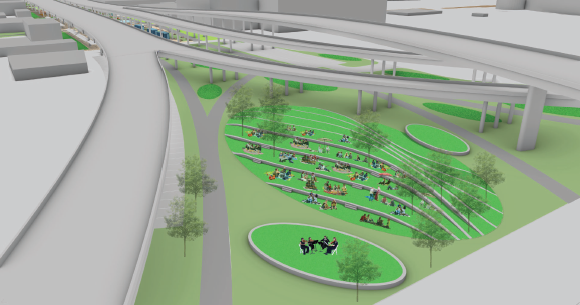
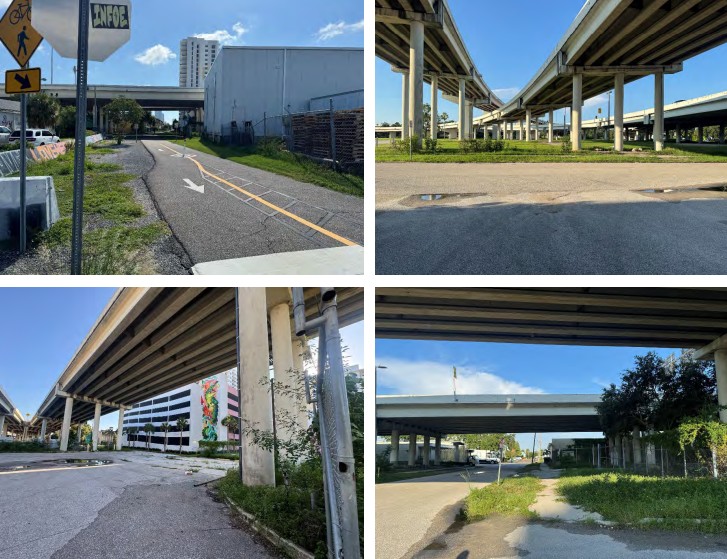
A community-led effort to transform 12 acres of blighted, underutilized space beneath Interstate 275 into a cultural park and urban trailhead in St. Petersburg has cleared a major hurdle.
City council members unanimously approved a $55 million framework for Trails Crossing on Thursday. First unveiled in 2021, the much-anticipated project will reconnect five neighborhoods long divided by I-275.
Local nonprofit Friends of Trails Crossing has spearheaded the public-private initiative, which includes safer walking and cycling routes, public art, recreational spaces and opportunities for small businesses. Councilmember Gina Driscoll credited Co-founder John Barkett for his “broad and bold vision to bring together more of our city.”
“I remember walking under the interstate with you, and both of us talking about the what-ifs,” Driscoll said. “This is what happens when you don’t stop there, but you keep going.”
Civil engineering firm LandDesign began the municipally mandated master planning process in March 2025. The city and Friends of Trails Crossing (FTC) each contributed $150,000.
Extensive public outreach followed. “This vote brings years of community vision and collaboration into a shared plan for action,” Barkett said in a statement.
“We are grateful to the city council, city staff, our partners and everyone helping turn a dividing line into a place of connection.”
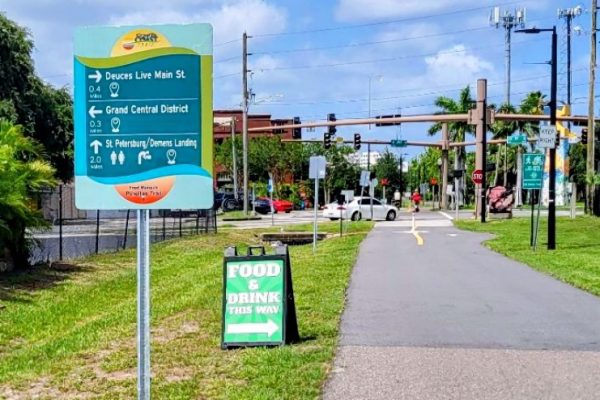
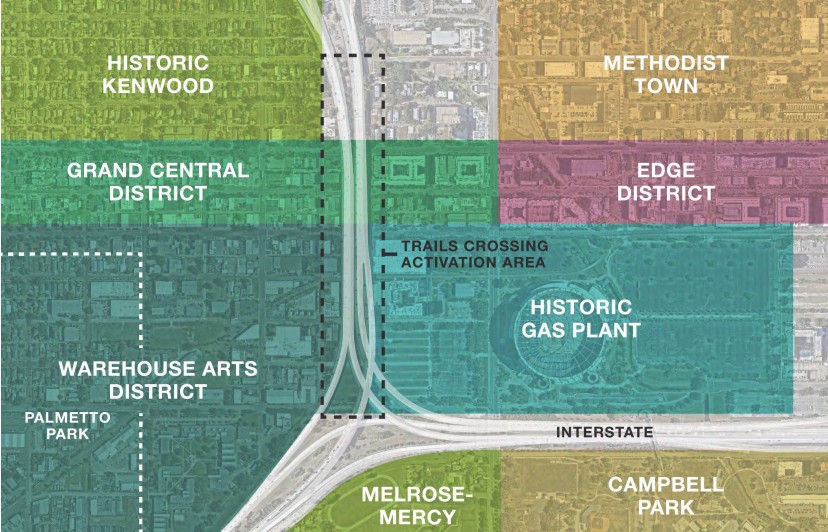
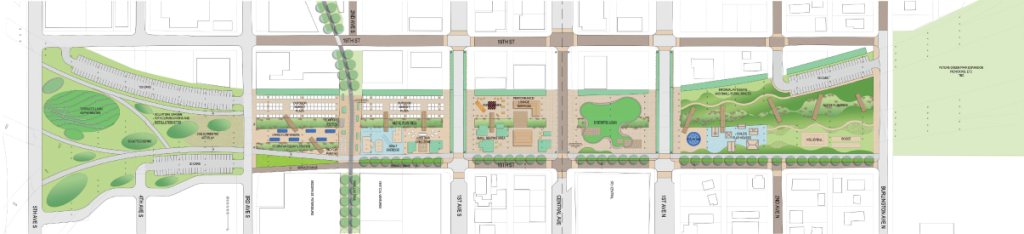
The project will convert a concrete canopy into a pedestrian corridor along 18th Street that links the Pinellas Trail with the Grand Central, EDGE, Warehouse Arts, Deuces Live and Historic Gas Plant Districts.
Trails Crossing will initially stretch from 1st Avenue North to 3rd Avenue South. Stakeholders will eventually expand the corridor to 5th Avenue North and 5th Avenue South.
Planned amenities include illuminated art walls, interactive sculptures, a children’s play area, pet zones, murals and a green amphitheater. Proponents have looked to other successful urban renewal projects for inspiration.
Tara Hubbard, an FTC board member, compared Trails Crossing to the Atlanta Beltline. She said the project will provide “catalyst infrastructure.”
“Atlanta shows us what a public-private partnership can do for an urban trail,” Hubbard said. “Bringing something like that to life here would be an incredible opportunity for our community now and for future generations.”
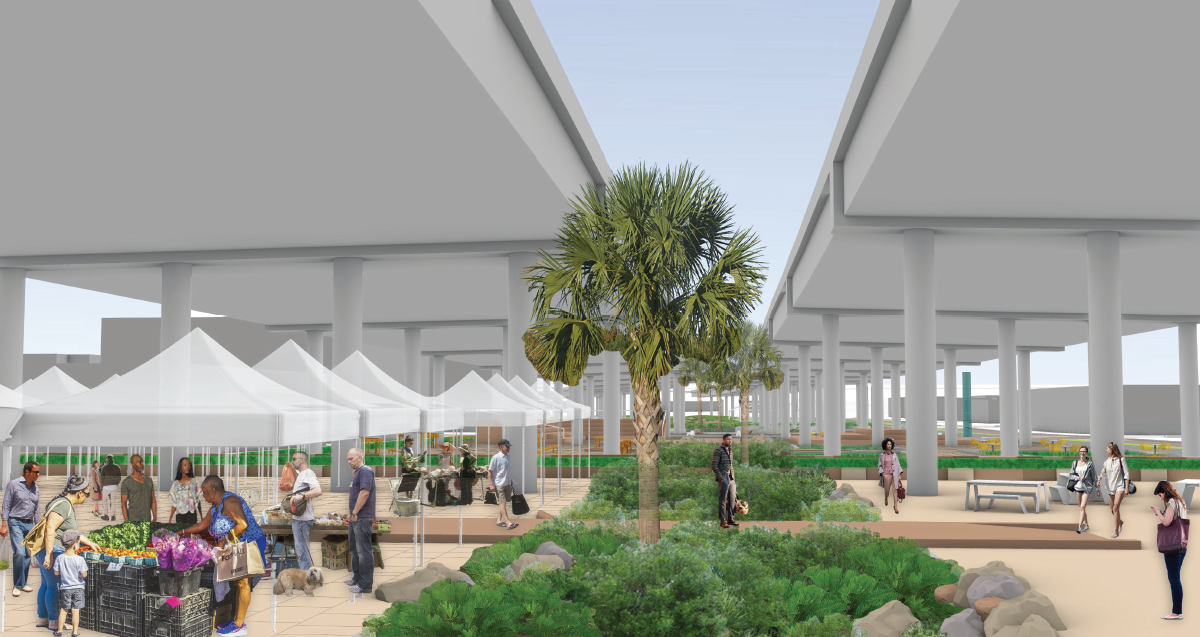
A large plaza and market space near Central Avenue will flank the Pinellas Trail. Cargo containers will house temporary art installations.
Lighted bollards, warning pavement strips and green planters will increase pedestrian and bicycle safety around the Pinellas Trail. The master plan also includes basketball and volleyball courts.
A large bioswale – a shallow, vegetated channel – and other environmental elements will support stormwater management. Councilmember Corey Givens Jr. praised the project’s potential to reconnect bifurcated neighborhoods, increase access to local businesses and provide much-needed urban green space.
“This is going to be that hub, that gathering space,” Givens said. “This is going to put St. Pete on the map.”
Project funding, however, remains a concern.
The first two phases will cost an estimated $23 million combined. LandDesign put a $55 million price tag on the four-phase project.
Council Chair Lisset Hanewicz noted the city’s approval does not include a financial commitment. The master plan states that an exact level of municipal funding remains undetermined and will be evaluated on a case-by-case basis.
“At this point, this is just a plan,” Hanewicz said. “There is no funding at this point.”
She added that FTC will lead fundraising efforts and pursue grants. “City participation will be coordinated where it’s appropriate based on that,” Hanewicz said.
FTC has already demonstrated some fundraising capacity with its $150,000 contribution to the master planning process. The group previously raised $30,000 for early conceptual renderings.
The organization also collaborated with the city to secure a $1.38 million U.S. Department of Transportation Reconnecting Communities planning grant. That funding supports traffic studies required to convert one-way corridors on Dr. Martin Luther King Jr. Street and 8th Street South to two-way traffic.
FTC believes that the award offers a model for future federal and state grants that require a municipality to serve as the lead applicant. The nonprofit also awaits agreements from the Florida Department of Transportation, which owns the land beneath the interstate.
For now, the council’s blessing allows FTC to prioritize phasing, create detailed designs, coordinate with outside agencies and pursue grants, philanthropy and sponsorships to offset implementation and operational costs.
The organization will help facilitate agreements with the City and other partners to define programming, maintenance and long-term stewardship responsibilities. Trails Crossing will receive a statewide spotlight at the Florida Greenways and Trails Foundation Summit in St. Petersburg when Barkett shares the project’s progress during a panel on Tuesday.
“Moving this forward is also something that the private sector should be interested in, passionate about and investing in,” Driscoll said. “I can’t wait to see how this unfolds in the coming years.”