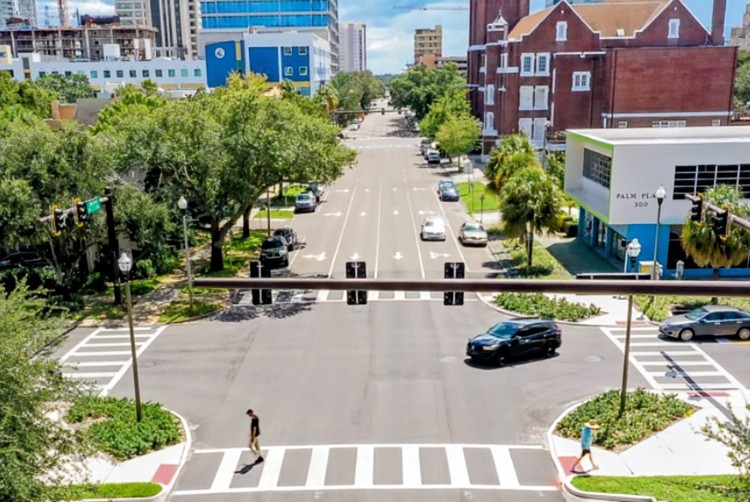
St. Petersburg, backed by $20 million in state funding, is moving to convert sections of one-way streets downtown to two-way traffic more than 25 years after first proposing the change,
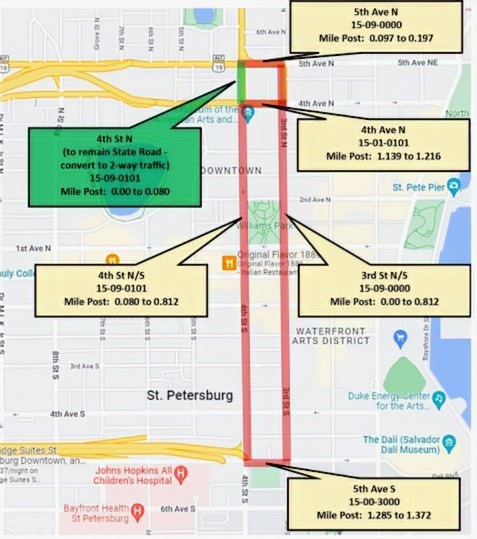
An intergovernmental agreement with the Florida Department of Transportation (FDOT), unanimously approved on Nov. 5, establishes a roadmap to reshape state-owned Third and Fourth Street between Fifth Avenues North and South. The city will eventually assume ownership of the affected roadways.
FDOT can now begin a five-year, $20 million work program that also extends to three connecting blocks. The initiative prioritizes pedestrian safety, placemaking and connectivity over the high-speed commuter routes designed during the mid-20th century.
Evan Mory, director of transportation and parking management, told city council members that the project would improve safety at three crash hotspots. He also noted that St. Petersburg is “certainly not alone in working through these two-way conversions.”
“Back in the 1960s and ‘70s, the conversion of these streets to one-way pairs from two-way was probably justified,” Mory said. “Downtown now serves a lot of purposes, and it’s a multi-faceted destination rather than simply a commute destination to drive to, through or out of as fast as possible.”
Mory highlighted a nationwide trend of municipalities reversing antiquated traffic patterns. Conversely, Fort Lauderdale recently abandoned plans to convert two-way streets to one-way, opting instead to retain the current configuration and add modern safety features.
St. Petersburg has gradually altered its one-way grid for decades. Mory presented a historical map showing that wide swaths of the downtown core were exclusively one-way traffic in the late 1990s.
The city has since reverted Mirror Lake Drive, First Street, Second Street, and Second Avenues North and South to two-way traffic. More recent plans to convert Third, Fourth, Eighth, and Dr. Martin Luther King Jr. Streets stem from the 2022 Downtown Mobility Study.
Mory said the joint initiative between the county’s planning agency, Forward Pinellas, the city and FDOT established two-way conversions as Priority One projects. That designation helped secure state funding.
“At first glance, one might think that one-way streets would be safer for pedestrians because people crossing would only have to look in one direction,” Mory explained. “However, traffic engineering firm Kittleson & Associates mapped out 16 conflict sequences that occur for pedestrians when one-way streets intersect with two-way streets.”
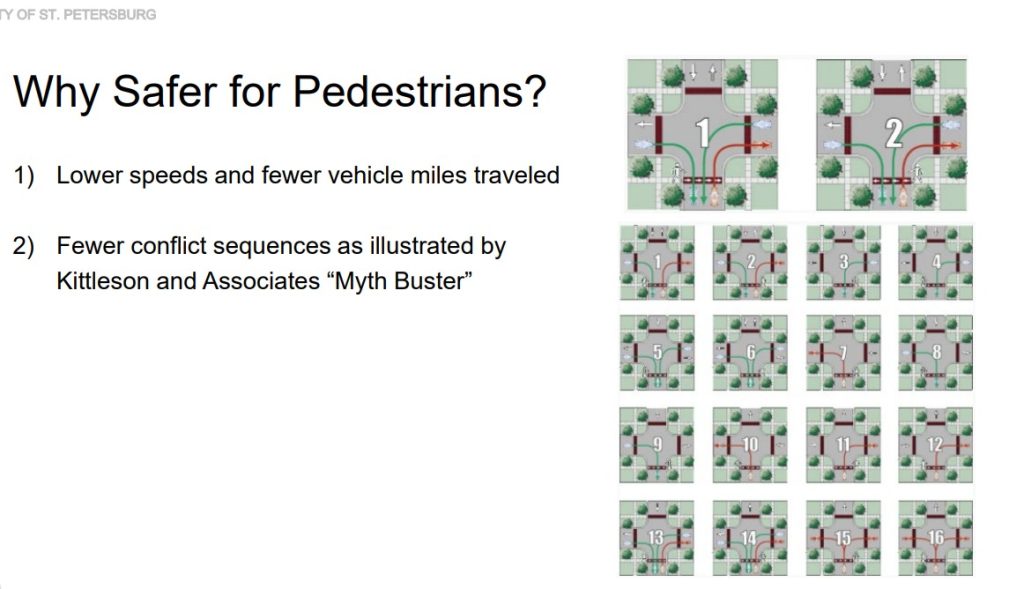
He said there is strong public support for the conversions. Benefits include less driver and pedestrian confusion, fewer crashes and additional access to local businesses.
“I’m happy to support this, mainly because it’s going to be safer for pedestrians,” said Councilmember Corey Given Jr. “I’m happy to hear that we are revisiting these conversations 25 years later. This is good news because our city has changed.”
Givens, however, also questioned the potential impact on nearby hospitals and emergency response times.
Mory clarified that the mobility study examined emergency response times regarding potential changes to Interstate 175, which are not moving forward. Conversion-related congestion on surface streets “should not be a major concern,” he added.
Some drivers could see their commute times increase by less than a minute, Mory said. He also believes that eliminating circuitous routes will create offsetting time savings.
“That will be looked at further in future traffic studies,” Mory said. “We’ll run the numbers again, see where we’re at in a few years.”
Mory said Third Street, which has less vehicular volume, is more likely to have dedicated multimodal transit space between the curbs. New traffic studies and public engagement will help inform FDOT’s final design.
Once the project breaks ground, Mory expects a six-to-nine-month construction timeline. That is contingent on additional approvals in two or three years, he said.
“This is not binding,” Council Chair Lisset Hanewicz said. “It’s just memorializing the agreement between the parties. And at some point in the future, there will be a binding agreement.”
According to city documents, FDOT plans to transfer jurisdiction and maintenance responsibilities to St. Petersburg in fiscal year 2028. Design work and the first $1.08 allocation are tentatively scheduled for fiscal year 2029.
St. Petersburg will receive $19.46 million for construction in 2031. Councilmember Gina Driscoll thanked Mory for “all that you’ve done to make this happen.”
“It has been a long time, and it’s exciting to see that this is finally moving forward,” Driscoll said.