St. Petersburg is diving headfirst into the future by incorporating AI into several city departments, including billing, water resources, building and permitting.
Councilmember Mike Harting requested an update on a nascent citywide AI strategy at a committee meeting Thursday. He and his colleagues want the mayoral administration to set a cohesive vision and lead the adoption process, rather than relying on departmental requests or letting vendors push products.
“Department directors are empowered and encouraged to identify technological solutions that will benefit their practice,” said Assistant City Administrator Tom Greene. “But yes, it’s being driven by the mayor and our leadership … and I think we’ve shown the evidence of that today.”
In May 2025, the city launched an AI Task Force featuring representatives from nearly every city department. The group is currently developing policies, conducting business and community engagement, partnering with the University of South Florida for staff development and developing a framework for pilot programs.
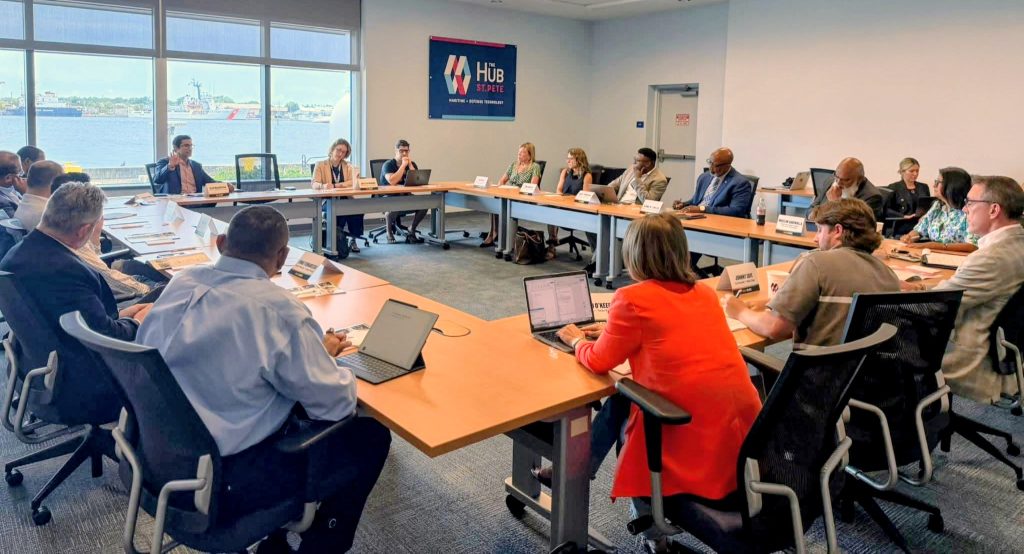
Mayor Ken Welch hosted a roundtable with local industry leaders at the Maritime and Defense Technology Hub in June. Attendees included stakeholders from spARK Labs, Cyber Florida, Jabil, Raymond James Financial and Lonestar Space.
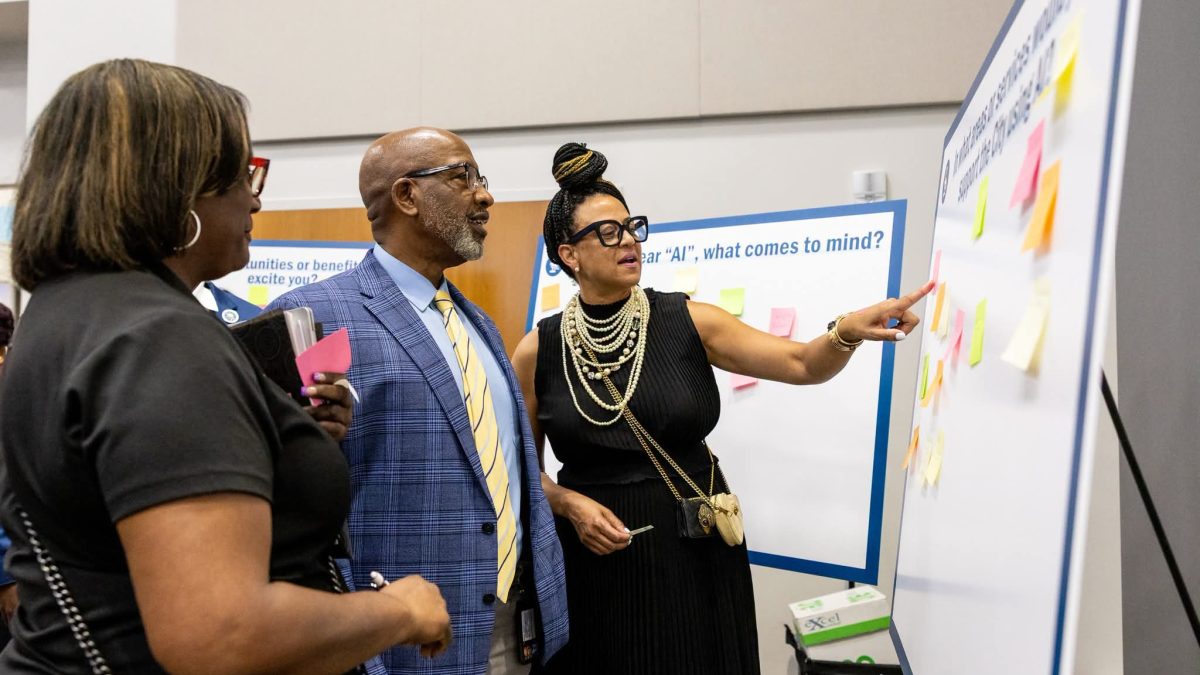
In late August, over 150 people attended an AI Open House at the Barack Obama Main Library. Officials solicited feedback, provided live demonstrations and launched a resident survey.
“More were very uncomfortable (36%) with AI than were very comfortable (23%),” said John Baker, special projects manager, of the survey results. “Which I thought was very insightful.”
Most residents, however, were “highly supportive” of using AI to predict flooding, water usage, and detect leaks. Contrary to campaign-season rhetoric, Welch’s administration is configuring a long-discussed platform to achieve those goals.
New platforms
Tyler Technologies’ software uses AI to identify abnormal water usage and billing anomalies and provide easy-to-understand account summaries. A virtual assistant can answer questions around the clock, explain charges, arrange payments and schedule service requests.
Officials can use the platform to forecast water demand and usage trends. “The biggest benefit is improving customer service, reducing manual work, identifying revenue loss and enabling our employees to make better decisions,” Baker said.
Administrators expect full implementation in the spring.
Tyler software can also streamline and guide applicants through the city’s much-maligned permitting process. The platform will eventually answer resident questions, identify quality issues earlier, improve consistency, and reduce manual reviews.
The building department already uses Avolve Software to review plans and check compliance. Baker said the system mitigates “a lot of back and forth” between staff and applicants.
Public works employees utilize Oracle Utilities Work and Asset Cloud Service (WACS), a platform that tracks and analyzes purchases, maintenance records and issues. AI will then help technicians decide if equipment needs additional repairs or replacement.
Baker said the city will integrate MentorLens, an AI-powered asset data-collection and condition-assessment tool, into the WACS platform. Field personnel take photos of equipment and the technology performs condition assessments and risk analysis.
Vialytics Ground Intelligence enables city vehicle cameras to detect pavement cracks, potholes and drainage locations, Bakers said. “Instead of having somebody spend hours and hours and hours going through all those videos, it says these are the 10 or 15 things that you need to take a look at.”
St. Pete Fire Rescue will use Peregrine Technologies software to enhance dispatch and response analytics, increasing effectiveness and improving patient outcomes by integrating previously captured data. Pinellas County already utilizes the platform.
“So, we’re embracing this,” Greene said of AI.
Concerns
Baker emphasized that AI is meant to reduce manual workloads rather than replace city staff. Approximately 50 employees have been trained on the new tools.
Officials must also ensure the platforms provide a cost benefit, adhere to data privacy rules and government reporting policies and support public record requests. Protecting sensitive information and maintaining trust are paramount.
Harting, an advocate for early adoption, compared the AI era to the advent of motor vehicles. Governments that welcomed the invention improved quality of life and “defined the rules.”
Many people were once terrified of cars, noted Muslim Gadiwalla, chief information officer. While they initially thought there would be “accidents galore,” he said society worked through those fears.
Councilmember Richie Floyd thought Harting and Gadiwalla’s analogy was appropriate, albeit for different reasons. The mass adoption of motor vehicles did cause widespread traffic deaths, he said.
After listing several other negative impacts, Floyd cautioned against failing to distinguish the various forms of AI. “I went to school for electrical engineering 15 years ago, and … we were learning about how the post office was using large-scale data analysis and neural networks to be able to read handwriting,” he said.
“A lot of the problems we’re going to run into are from generative AI,” Floyd continued. Those tools that you listed earlier, that are use-specific, those are things we should definitely embrace and engage in.”
Generative AI responses are often difficult to verify, Floyd said. He also believes that an “art city” shouldn’t use the technology for creative endeavors.
City policy states that “AI should not be used to create illustrations or other visual work,” noted David Thompson, director of government affairs.
Moving forward
Councilmember Brandi Gabbard said permitting software “is not there yet to be able to really read all of that code,” provide accurate reviews regarding intent, distinguish precedent and streamline the post-submittal process for customers and employees.
“But it’s going to get there, and we know that,” she said of the rapidly evolving tech. “The city is going to have to eventually deal with AI, and either we are the ones leading that charge, or we’re just going to be reactive and responsive to what the contracting community is moving forward.”
Committee members unanimously agreed to discuss how AI can enhance building and permitting operations in ongoing meetings regarding the mayoral administration’s citywide strategy. Council Chair Lisset Hanewicz, like Floyd, said they needed additional information regarding specific use cases.
“This is not a conversation that is going away.”