Pinellas County Commissioners successfully reduced the property tax rate to its lowest level since 1989. Doing so required eliminating jobs, slashing nonprofit funding, and departmental budget cuts.
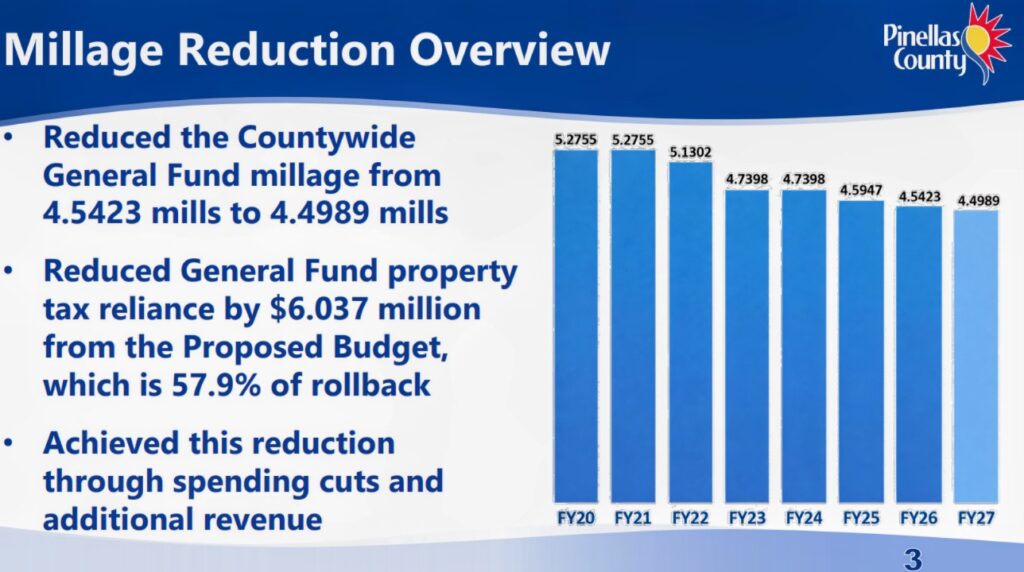
Commissioners unanimously adopted the fiscal year 2027 budget on Sept. 24 following “nine months of intensive review and difficult tradeoffs,” as stated in a subsequent announcement. The county’s millage rate – $1 per $1,000 of taxable value – decreased from 4.5423 to 4.4989 mills.
Property owners will now save $4.34 for every $100,000 of taxable value. Social Action Funding grants for programs that help vulnerable children, low-income families, seniors and veterans will plummet by about 60%.
“We took a hard look at every area of county government to find responsible ways to reduce costs, find alternative revenue sources and ease the burdens on our residents,” said Commission Chair Dave Eggers in a statement.
“I’m proud of the work that went into navigating an especially challenging budget process this year.”
County Administrator Barry Burton previously recommended reducing the government workforce by 44 positions, with 35 supported by the general fund, to balance the budget. He said the goal is to “reassign staff as we have position vacancies to generally prevent having to lay off good employees,” in a letter to commissioners.
An advisory board that oversees the Social Action Funding initiative recommended providing 17 nonprofits with roughly $1.7 million in grants, consistent with prior allocations. Burton suggested awarding $667,000 to seven organizations that have previously received funding.
Commissioners Brian Scott and Chris Latvala advocated for ending the program altogether. Eggers and Commissioner Rene Flowers expressed concern over pulling the rug from under longstanding partners.
The board ultimately reached a compromise by agreeing to distribute the $667,000, using one-off reserve money rather than recurring property-tax revenue. That allowed the county to reduce the millage rate further without making additional cuts to transportation and drainage infrastructure funding.
However, the Social Action Funding program will end next year.
The last awarded nonprofits include Abilities of Florida ($99,000), Boley Centers Inc. ($77,115), Family Resources Inc ($99,000), Preserve Vision Florida Inc. ($99,500), Seniors in Service of Tampa Bay Inc. ($99,999), Shirley Proctor Puller Foundation Inc. ($93,789) and the St. Petersburg Free Clinic ($99,000).
Flowers, in a subsequent social media post addressed to organizations that have relied on Social Action Funding, said she sincerely hoped her notice would provide “enough time to to begin to plan for your fiscal needs in advance.”
“Please know that I did my best to save this line of funding,” said Flowers, the commission’s lone Democrat.
The county’s budget announcement notes that the commission lowered the millage rate for the fifth time in six years, “despite rising costs and tens of millions of dollars in unfunded state and federal mandates.” A resident with a $400,000 home will now save $17.36 on next year’s tax bill.
Additional “difficult reductions” include cuts from every department under the county administrator, which saved $16 million. Officials also decreased funding for transportation infrastructure by $1.5 million.
The county’s general fund will no longer support sexual assault victim services. Shifting those costs solely to private hospitals will save $1 million.
“Despite those reductions, the adopted budget protects life, health and safety, along with essential infrastructure,” states the announcement. “The budget also maintains commitments to beach nourishment, coastal management, surface-water improvements, environmental protection and hurricane readiness.”
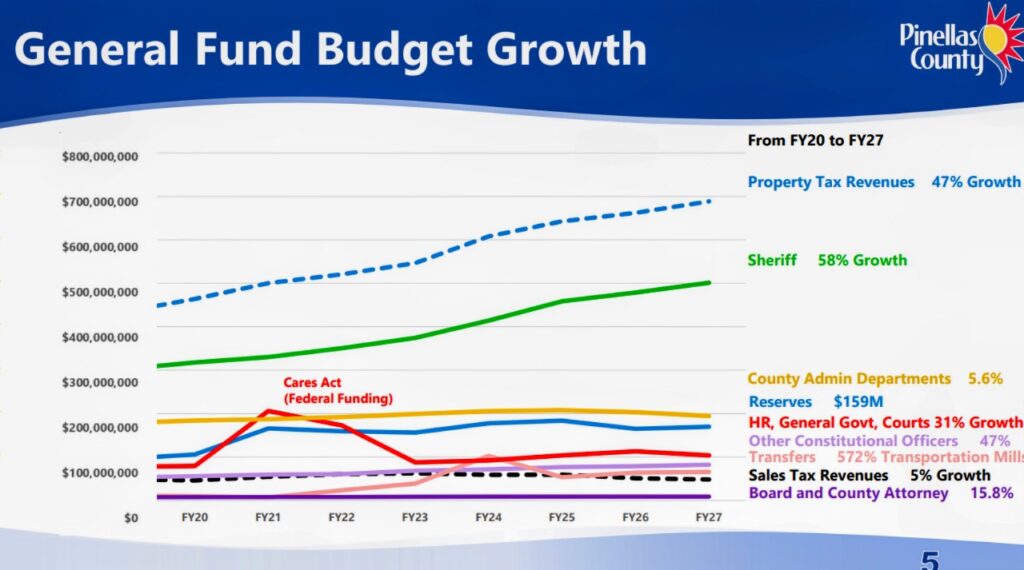
Funding for the Pinellas County Sheriff’s Office increased by 4.7%, to $501.3 million. That is $7 million less than what was initially requested.
Commissioners postponed plans to defund Weedon Island and Shell Key Preserves – and transfer control to the state – for one year after facing fierce public opposition to the cost-cutting measure.
Instead, officials have essentially doubled parking rates at Fort De Soto, Sand Key, and Fred Howard Parks.
Those maximum daily fees have increased from $6 to $12, or $3.50 hourly, which will generate an estimated $3 million annually. Pinellas would have saved $550,000 by ceding control of the nature preserves.
Property tax reform has loomed large over the budget process. Pinellas is projected to lose $2.31 billion in revenue by the end of fiscal year 2032 if voters approve Amendment 3 in November.
Eggers noted that a potential fiscal cliff is “clearly right in of us.” Regardless of whether the amendment passes, the county has received a “strong message” from the state to ensure that “we’re doing things effectively, efficiently and in as small of a government as we can,” he said.
“So, we’ll see. That’s work ahead,” Eggers concluded. “For this day, I think, congratulations to everybody.”