Two new resident-led committees will have a significant say in how St. Petersburg spends hundreds of millions of dollars on resiliency-related projects.
The first, a Resilience Advisory Committee, will review a citywide, nature-based storm-hardening plan, offer a community perspective, and recommend changes or opportunities. The second, a GO (general obligation) Bond Advisory Committee, will provide financial oversight and ensure transparency if voters approve a $600 million issuance to finance critical water, stormwater and sewage projects.
After much discussion, city council members approved a framework for both initiatives at a committee meeting Thursday. Debate centered on district representation, and whether ensuring geographic diversity would risk quorums or dilute subject-matter expertise.
Property owners will see their tax bill increase by $96 annually for every $100,000 of taxable value if voters approve the bond referendum on Nov. 3. Administrators initially planned for that committee to have nine members, five with expertise, but with no guarantee that all eight council districts will have a community representative.
“The entire city is going to pay for this,” said Councilmember Brandi Gabbard. “There is not a single district in our city that was not impacted either in (Hurricanes) Helene or Milton, or will not be impacted by future storms. Every single district must have a voice.”
The bond committee would ensure “spending consistent with what voters approve” on an ongoing basis, explained Maeven Rogers, sustainability and resilience director. Members would review staff reports, project prioritization and independent audits, host public forums, and deliver written reports to the city council.
Rogers said anyone with financial ties to GO bond projects is ineligible. The group will meet at least quarterly.
“This provides full transparency – we come to you before any dollar is spent,” Rogers said of the committee. That way people really understand where the dollars are going and have some decision-making in the process.”
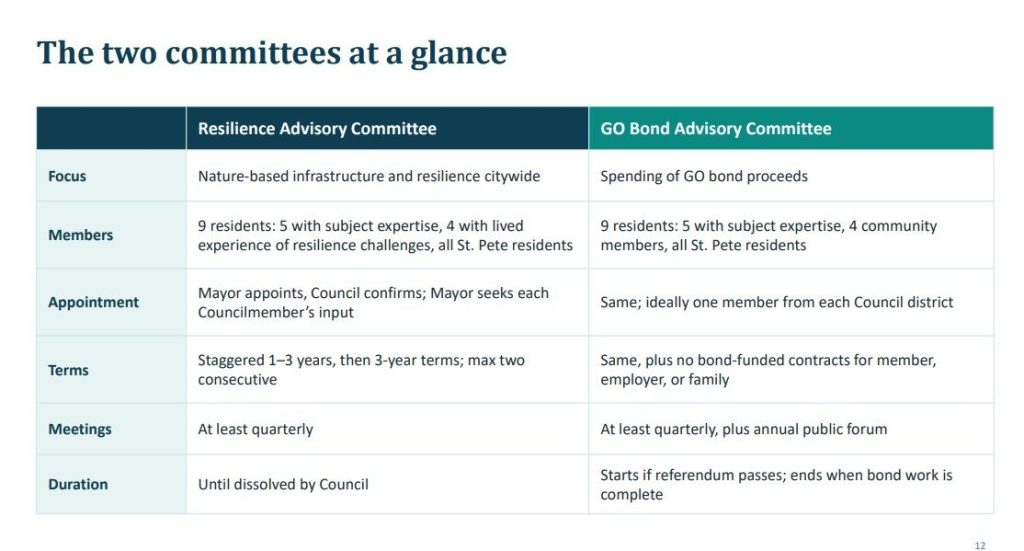
Multiple council members suggested increasing the number of members to 12 or 13 residents to ensure equal representation and five subject-matter experts. They would initially serve for one to three years before the city implements three-year terms with a six-year maximum.
Assistant City Attorney Brett Pettigrew called seven to nine members the “sweet spot.” An increase could make meetings “unwieldy.”
Councilmember Gina Driscoll opposed increasing the number of seats. She warned that large panels often suffer from attendance drop-offs and diffused responsibility, and emphasized the importance of technical expertise.
“We need to have that efficiency and focus on the money,” Driscoll said. “It’s not just about what projects are happening, it’s about making sure that those dollars are spent the way they’re supposed to be.”
Councilmember Richie Floyd motioned to establish a 12-member board. He, Gabbard, and Councilmember Corey Givens Jr. voted in favor. Councilmember Deborah Figgs-Sanders, not part of the Health, Energy, Resiliency and Sustainability Committee (HERS), also supported the increase.
Driscoll voted against the measure. The full city council, however, must still approve the framework.
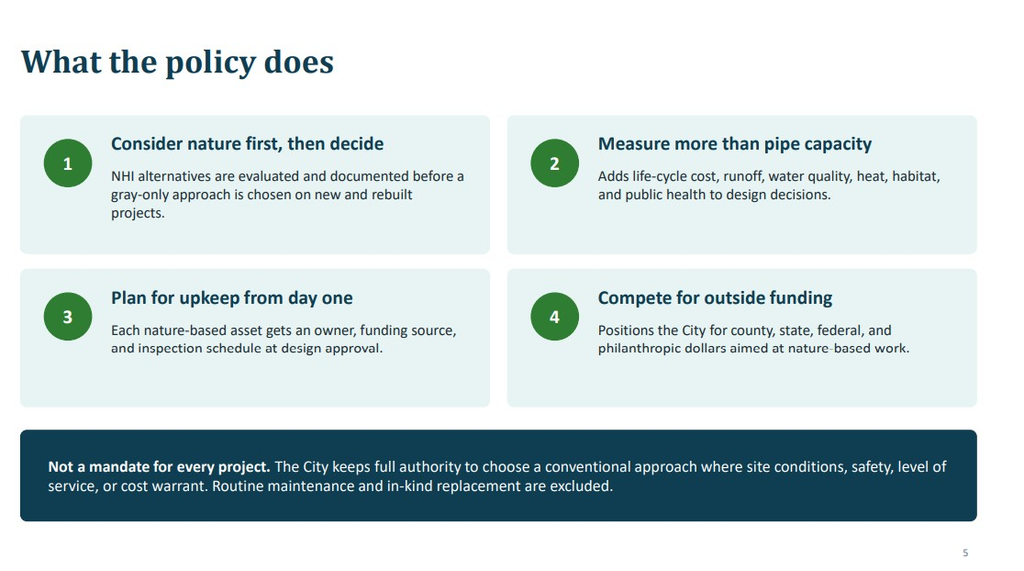
The resiliency advisory committee will provide independent advice on nature-based infrastructure and resiliency strategies, Rogers said. “We have a lot of work for them to do.”
Rogers noted that a Florida Department of Environmental Protection grant requires officials to form the committee. The committee will “definitely get into policy discussions” on initiatives that mitigate flooding, storm surge and heat, and protect shorelines and vulnerable neighborhoods.
The board will include nine residents, five with expertise and four who have experienced resilience challenges. “I think the concerns are exactly the same,” Floyd said of the two new committees.
“It’s a lot easier to find someone who lives in a district than it is to find a civil engineer who has time to come serve on this board.”
Givens motioned to include five residents with lived experience and four subject-matter experts. Members will serve staggered terms, the same as the bond committee.
Gabbard said the city should prioritize applicants from each council district rather than those who live in areas with the highest resiliency risk. Her colleagues agreed, and the motion passed unanimously.
Figgs-Sanders expressed concern that the mayor, not council members, will appoint residents to both committees. Mayor Ken Welch is up for reelection, and trailed former Gov. Charlie Crist by nearly 15 percentage points in the August primary.
“We should have more voice in who represents our districts,” Figgs-Sanders said.
The city’s charter guides that structure, Pettigrew said. However, “it’s common for the mayor and council members to collaborate” on appointments.
In addition, the administrative resolution explicitly states that council members must confirm each appointment and reappointment. The HERS committee did not discuss Figgs-Sanders’ concern further.