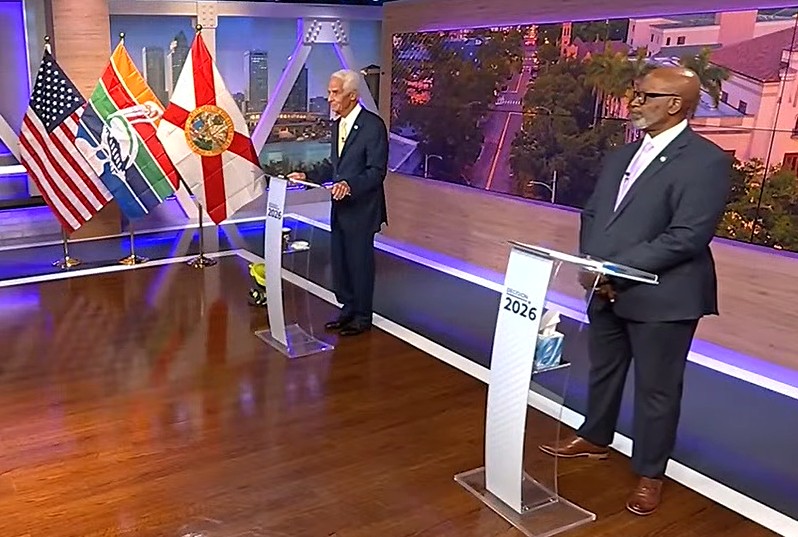
Mayor Ken Welch and former Gov. Charlie Crist outlined competing visions for St. Petersburg in their final, and only televised, debate before the Nov. 3 election.
Welch touted the city’s progress and systemic investments. Crist positioned himself as a seasoned statesman who will bring financial relief to overburdened taxpayers throughout the hour-long forum, hosted by Spectrum Bay News 9.
The candidates were not provided questions in advance, nor were they allowed to read scripted talking points.
Welch framed his tenure as a fight for progress through unprecedented challenges. He argued that the city is moving aggressively forward despite recent obstacles, and voters should “elect someone who’s been here for the fight, that helped this city recover from five hurricanes.”
“Charlie (Crist), you weren’t here for that – you weren’t here for anything,” Welch said. “It’s easy to speak after the fact and Monday morning quarterback.”
In his opening remarks, Crist, also a former congressman, highlighted his bipartisan support. All four living former St. Petersburg mayors, Republicans and Democrats, and three sitting city council members endorsed his candidacy.
“I’m very proud of that, and I think they’ve done so because of my vision and my plan for the future of our beautiful city,” Crist said.
The Trop and the Rays
Some of the sharpest exchanges centered on the Historic Gas Plant District, now home to Tropicana Field, and the Tampa Bay Rays. The 86-acre site once boasted the city’s largest enclave of Black residents, who were displaced during stadium construction.
Crist did not mention the Gas Plant’s history or long-deferred promises of economic opportunity to its former inhabitants. He pledged to establish a “blue-ribbon panel” to review the $8.7 billion redevelopment proposal Welch selected in July.
A reimagined district should have a “sizable park,” Crist said. “I think it should be very green … and I think some multi-use development would be appropriate as well.”
Welch believes his selected proposal will finally fulfill promises of economic inclusion. “It’s about so much more than green space,” he said.
Stuart Sternberg, former owner of the Tampa Bay Rays, killed a previous redevelopment deal in March 2025. Previous administrations that endorsed Crist couldn’t reach a long-term agreement with the team, Welch noted.
Crist bemoaned the thought of losing the Rays when their lease at the Trop expires after the 2028 baseball season. He recalled the “sweat equity” that went into securing the franchise and said the door should remain open until construction on a new stadium commences in Tampa.
“Not trying everything possible to have them stay here is almost unconscionable,” said Crist, who also addressed the matter in his closing remarks. “Unfortunately, Mayor Welch, it looks like we’re losing the Rays on your watch.”
Welch, however, rejected the idea of writing a blank check to keep the franchise. He highlighted the team’s shifting demands after Hurricanes Helene and Milton and said the city no longer needs baseball to validate its status.
“Once the Trop was damaged, the previous ownership was asking upwards of $300 million,” Welch said. “They never had a defined amount of money that we could pay to keep them here when we have obvious needs in our infrastructure that were laid bare by the storms.”
Resilient infrastructure upgrades
Welch advocated for a $600 million bond issuance, supported by an additional property tax, to finance critical water, stormwater, and sewage projects. “We’re not going to kick the can down the road like previous administrations have done,” he said.
Crist opposes the bond issuance, which requires voter approval. Residents already struggle to overcome soaring living costs, he said.
“The last thing I want to do is burden you with a bond that puts more debt on the city of St. Petersburg than we have right now,” Crist continued. “I think a lot of these issues should have been addressed earlier.”
Affordability
To address affordability, Crist pitched a 0.4-mil property tax reduction. Residents with a $300,000 home would save $120 annually. The city would lose approximately $15 million in yearly revenue.
Welch again questioned what services Crist would cut under his proposal. “The truth is, all of our property taxes do not pay for police and fire by themselves,” he said.
“So, we’re going to have to cut other things, or police and fire, as we did when he (Crist) was governor and rolled through that property tax reduction.”
DEI
Senate Bill 1134, which prohibits municipalities from funding or promoting any activities related to diversity, equity and inclusion (DEI), will become law on Jan. 1. Crist, noting the removal of multiple street murals in St. Petersburg, said state-sponsored culture wars have already impacted the city.
“What I was surprised by is that our mayor decided not to fight that,” he added. “It seems to me that if you’re not going to fight for free speech for the citizens of your city, maybe you ought not be the mayor.”
Welch, endorsed by Equality Florida and the Stonewall Democrats, said he has “been in the fight.” His administration sought an exemption from the Florida Department of Transportation, and he called attempting to override the governor “illogical.”
Rep. Michelle Rayner read a letter Welch penned opposing the “horrible” DEI legislation on the House floor. “Why do you want the office if you’re not going to do the homework?” Welch asked his opponent.