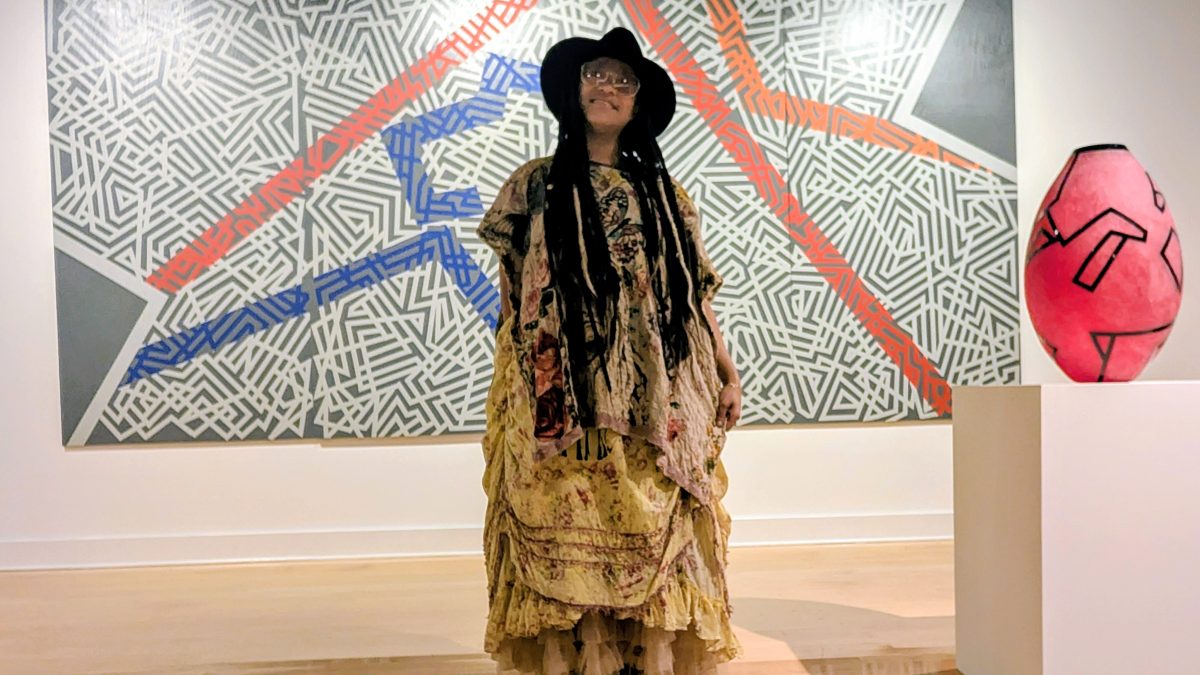
Acclaimed artist Ya La’Ford spent over two years exploring the intersection of ancestry, humanity, and geometry to craft her most comprehensive exhibition to date.
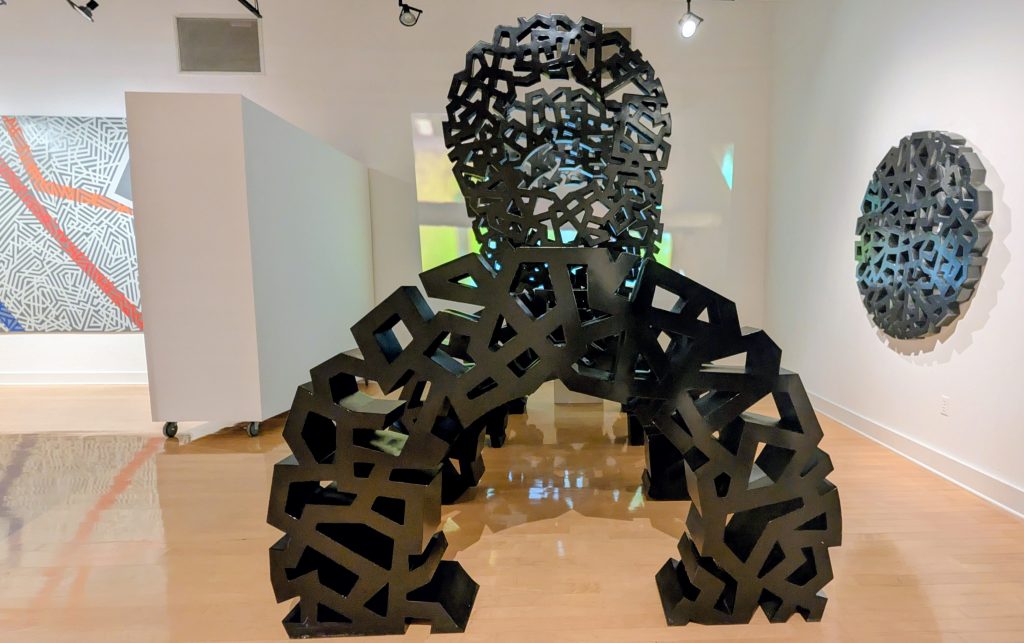
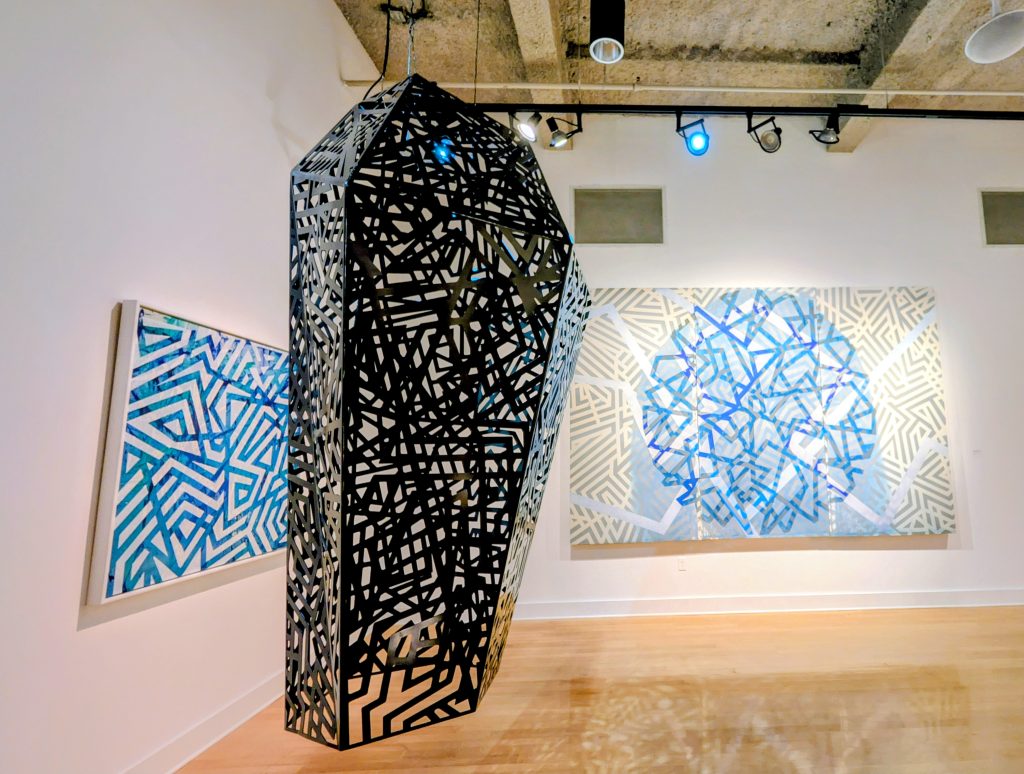
Known for her large-scale sculptures, La’Ford used glass, wood, steel, aluminum, print and digital media to create Kaleidoscope: The Spirit within the Geometry of Wind, Water and Dreams. The Scarfone/Hartley Gallery at the University of Tampa will host a public reception Saturday evening to celebrate the exhibition opening.
Kaleidoscope collapses time, medium and human memory into an immersive, physical experience. La’Ford said the diverse materials were a necessary vehicle to capture the formless elements of the human condition.
“Kaleidoscope is about giving form to things that we experience deeply, but can’t hold still,” La’Ford said. “I was drawn to all of these materials because they’re constantly changing. You cannot hold wind in your hand. Water moves around whatever it encounters. Dreams can feel completely real, and then they disappear when you wake up.
“I wanted to explore how geometry could give a temporary structure to those experiences without trapping them.”
The conceptual foundation for Kaleidoscope took root during a trip to Senegal. In 2024, La’Ford was one of only two American artists invited to the biannual Dakar Biennale, Africa’s longest-running and most prominent contemporary art show.
While there, La’Ford confronted the often painful history embedded within the surrounding landscape. Standing at Senegal’s infamous Door of No Return, a historic departure point for enslaved Africans, she looked out at the Atlantic Ocean.
La’Ford, of Jamaican descent, said the sea became more than an environmental feature at that moment. “That water holds stories of forced movement, separation and the survival of a diaspora.”
“Water is both a separator and a connector,” La’Ford philosophized. “Water carries history. Water changes borders. Water erodes physical structures. Water also refuses to keep memories in one place, and that’s so closely aligned to Kaleidoscope.”
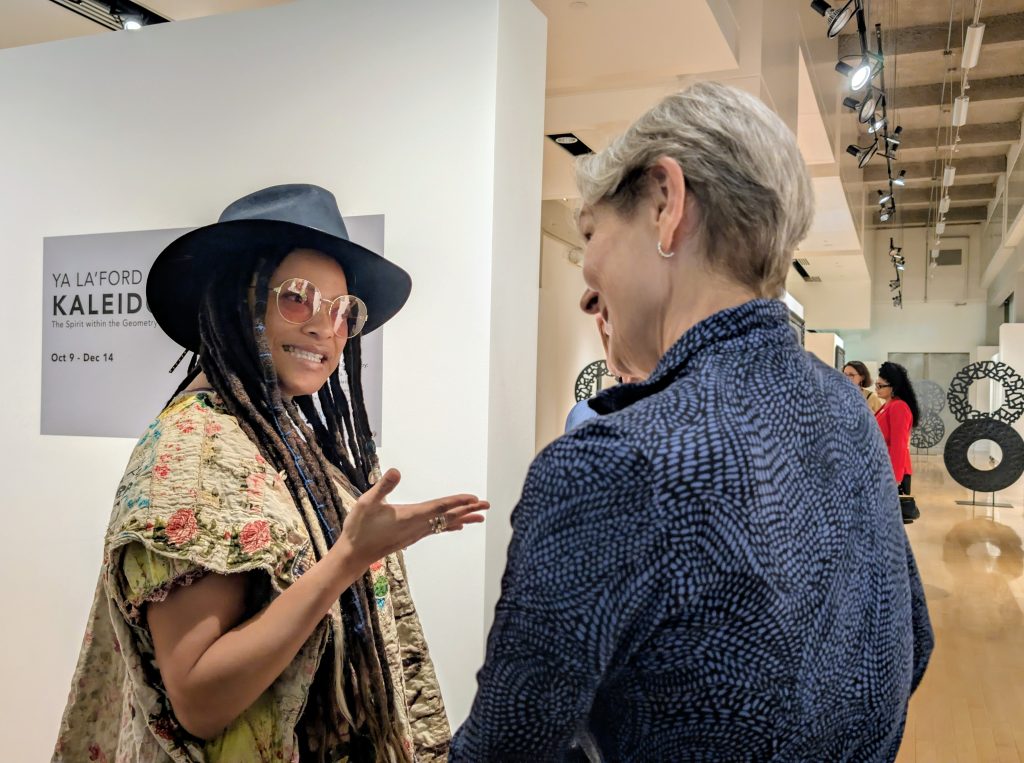
La’Ford rejects that a line is merely a mark on a surface. She believes it can carry tension, direction, and history. Lines begin in one place, intersect, change direction and arrive at another point, she explained.
“I think that’s much like the human experience,” La’Ford continued. “We move through places and relationships, carrying memory and ancestry with us.”
Conceptual connection was a primary focus for Jocelyn Boigenzahn, director of the Scarfone/Hartley Gallery and the exhibition’s curator. She has known La’Ford for more than a decade.
The two spent the past year working together as “brainstorm buddies,” Boigenzahn said, meticulously planning Kaleidoscope’s layout to ensure sightlines matched the exhibition’s overarching theme. “Your eye will catch one pattern and carry it to the next object.”
Just as a physical kaleidoscope creates new configurations with every turn, La’Ford believes memory and experience shift depending on where a person stands. “The work is not meant to be understood in one fixed position,” she said of the exhibition.
“From far away, you may see a system or a pattern, but as you get closer, you’ll begin to see the individual marks, the surfaces, the shadows and the constructions,” La’Ford elaborated. “I think that your own movement becomes a part of the experience, a part of the art, and intersects you into the space.”
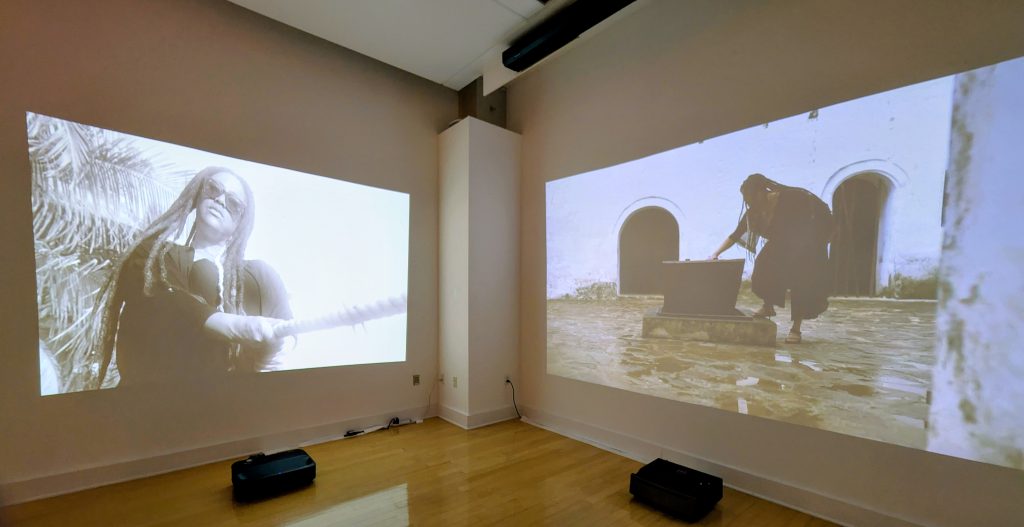
To further activate the gallery, Boigenzahn and La’Ford incorporated two digital video projections featuring the artist moving in and out of the geometry. Scenes from Senegal’s Door of No Return also feature prominently.
La’Ford said the space allows introspective attendees to become “actors in this major scene.” While she is the star, so to speak, viewers have their “own role in my kaleidoscope.”
“My body was kind of the archive, and my face was very much the testimony,” La’Ford explained. “The geometry is the map. The water would play the role of memory. The Atlantic would be my ancestors’ passage. The video is the time, and the return is the reclamation.”
She emphasized that her art belongs to the people, who don’t need to understand everything to feel a rhythm, cycle, and sense of movement. Ultimately, Kaleidoscope invites reflection on the unseen forces that guide humanity.
La’Ford intentionally leaves enough openness for the audience’s own experiences to complete the narrative. “I really hope that you leave the exhibition thinking about invisible things that shape us – maybe the places that we’ve been, the people we’ve encountered, the memories that we carry, the paths that have brought us to where we are now,” she said.
Kaleidoscope is free and open to the public Monday through Friday, 10 a.m. to 5 p.m., through Dec. 11 at the University of Tampa.