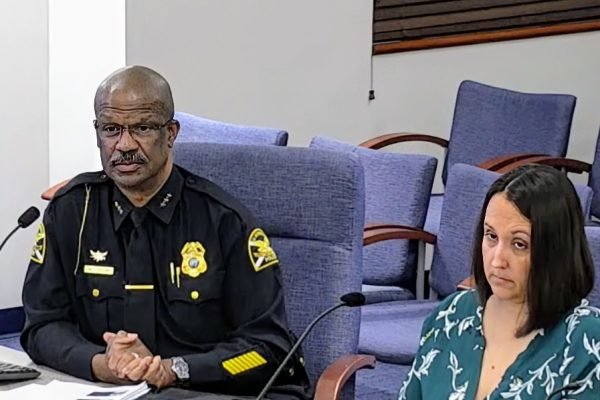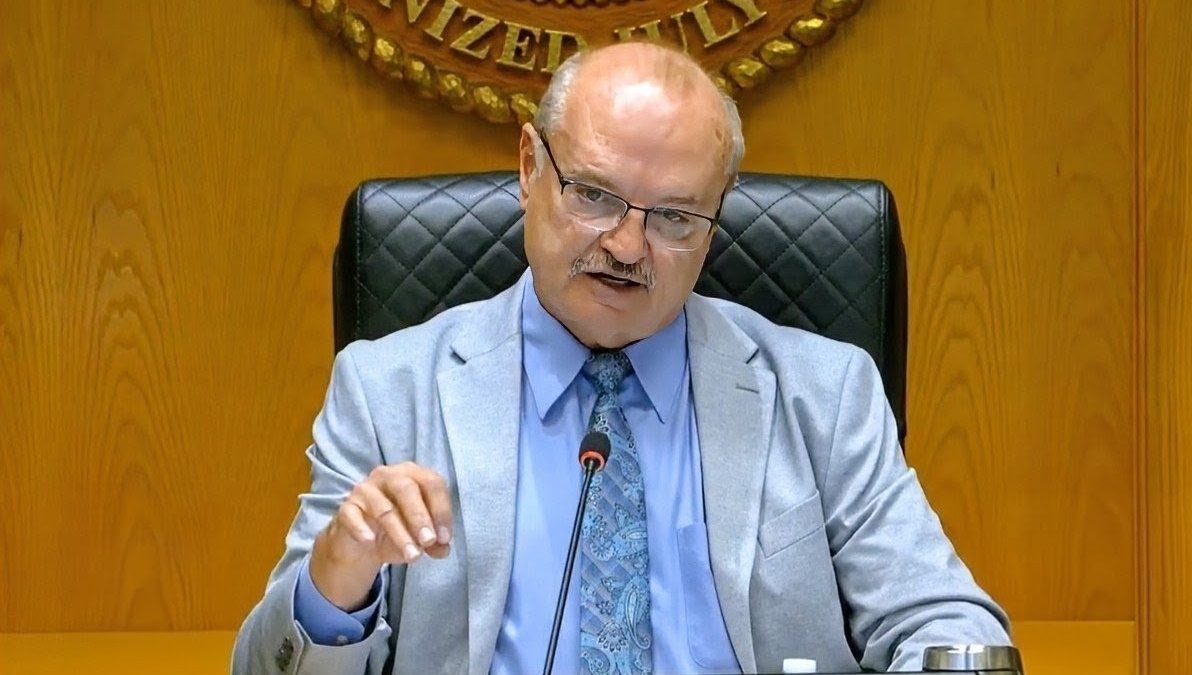
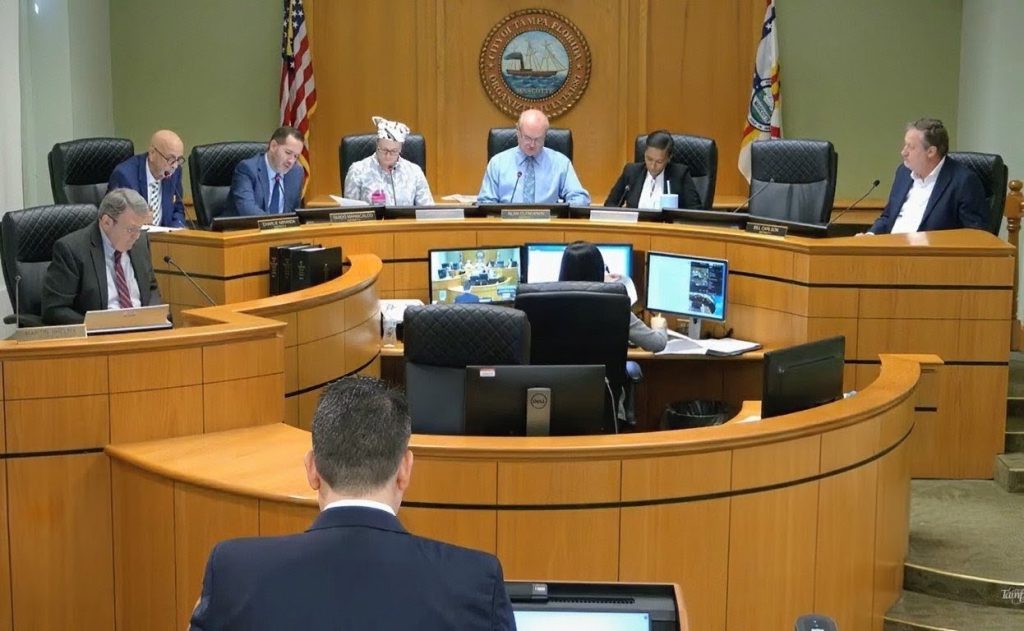
An institutional rift at Tampa City Hall deepened Thursday after Council Chair Alan Clendenin accused Mayor Jane Castor of orchestrating a covert campaign to block proposed limits on her mayoral authority.
Despite the alleged executive interference, council members advanced all 15 charter amendments through a preliminary reading. A final vote on Nov. 19 could restructure the balance of power between Tampa’s mayor and its legislative body.
Before Thursday’s votes, Clendenin detailed what he called a coordinated effort to sway individual council votes. He said records showed that the mayor’s political director distributed documents criticizing the proposed charter changes to select council members while excluding others.
At least three of seven council members, including himself, never received the communications, Clendenin said. “The records show that even among the council members who received these communications, the information was not identical,” he said.
“Different members received different versions with different arguments and different financial estimates concerning the very same charter amendments,” Clendenin said. “I have serious concerns that this was a deliberate effort to influence individual Council members by selectively controlling the information they received.”
Some of the materials were placed in sealed envelopes and hand-delivered to targeted council members, which Clendenin found “deeply troubling.” After speaking with Castor, he confirmed the political director acted at the mayor’s behest.
“I have absolutely no problem with the mayor disagreeing with these amendments. That’s her right,” Clendenin said. “But I do have a problem when the information is selectively distributed to individual council members, particularly when some of this information is misleading or incomplete.”
Clendenin also criticized the administration for a perceived double standard. He noted that Castor frequently tells council members to “stay in our lane” regarding executive policy while attempting to manipulate the legislative process behind the scenes.
The public admonishment prompted an even harsher rebuke from Councilmember Bill Carlson, a longtime critic of Castor. He accused the mayor’s office of intimidation, bullying and illegally conducting political activities on city time.
“We need to bring back the charter amendment that allows us to fire staff,” Carlson said. “We also need to be able to fire the city attorney.”
Carlson added that despite past attempts to mend the relationship, the administration refused to cease “opposition research” and leaking information. He has largely refused to meet with the mayor for roughly two years over her office’s focus on “dirty politics” rather than public service.
Following the accusations, City Attorney Scott Steady addressed the council to clarify the boundaries of the mayor’s actions. He emphasized that Castor’s lobbying did not violate any laws.
Clendenin acknowledged that legal reality and never formally accused the administration of violating Florida’s Sunshine Law. Instead, he argued the covert tactics represented a moral failure and a breach of institutional trust.
To preserve the integrity of the charter review process, Clendenin said all council members should have equal access to accurate information. “If we pass it, it goes to the voters.”
With the accusations aired, council members pivoted to the proposed charter amendments. Castor pushed back against the changes to Tampa’s strong mayor form of government in October.
“I am deeply concerned that council members are now considering changes that would disregard much of that thoughtful work and fundamentally alter the balance of responsibilities that has served Tampa for decades,” Castor said in a statement.
“We created this independent citizen-led process for a reason, and its analysis should not be cast aside for a power grab.”
Establishing an independent Inspector General was a major point of contention. Administrators warned the move would duplicate the city’s existing audit department.
Clendenin said the mayor’s office failed to distinguish between routine financial auditing and independent investigatory authority.
He also contested warnings that allowing the supermajority to override executive orders could jeopardize emergency management operations. Clendenin argued that distributed materials failed to explain the proposal.
Administrative documents suggest that adding independent council staff would cost the city nearly $1 million. Clendenin countered that those figures were based on hypothetical positions rather than what the amendment proposes.
One of the most debated measures concerned mayoral term limits. Tampa mayors cannot serve for more than eight consecutive years.
However, they can return to office after sitting out a four-year term. The amendment would close that loophole and bar anyone who has held the mayor’s seat for more than six years from running again.
Carlson said the proposal’s “reset” clause would allow any living mayor to serve an additional eight years. He suggested exempting the 2027 race, which includes former Mayor Bob Buckhorn, rather than wiping the slate clean for all past officeholders.
That amendment received the only dissenting votes and passed 4-2, with Councilmember Charlie Miranda and Carlson opposed. Voters will have the final say in March following a second reading and public hearing next month.
“These charter amendments aren’t about any one mayor or any one council,” Clendenin said. “They’re about how the city is governed for years to come.”