For decades, Drew Park was left off Tampa’s priority list; now, some stakeholders are bracing for stadium construction chaos without any guaranteed short-term relief.
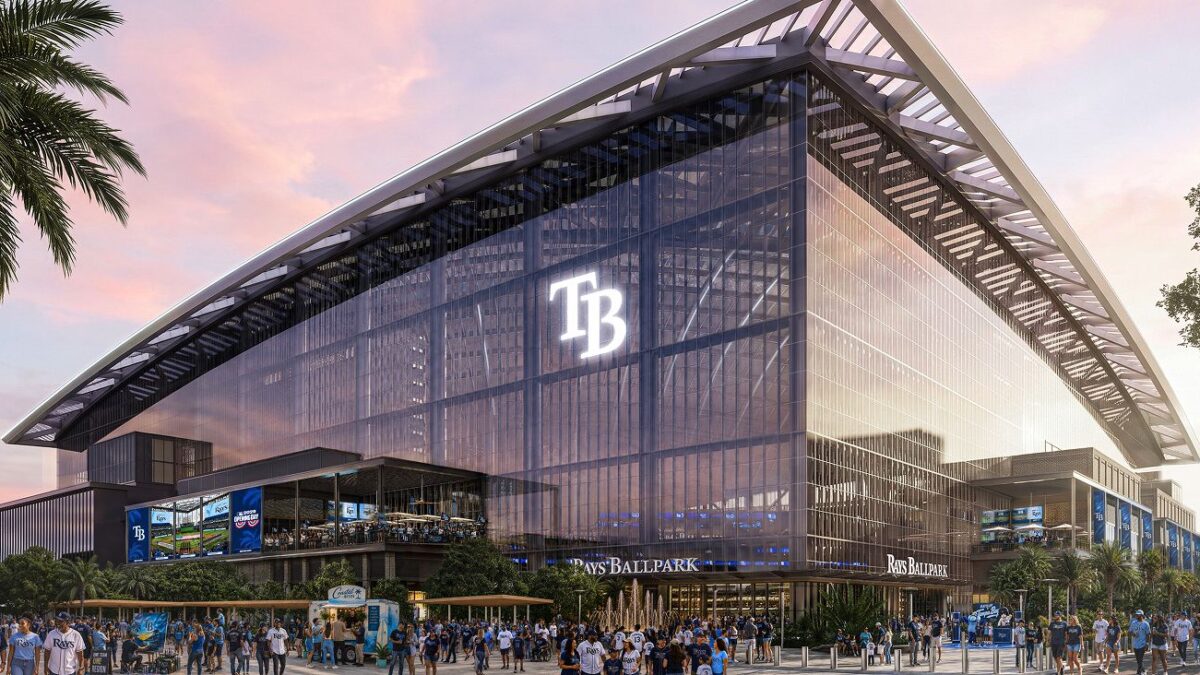
The community redevelopment area (CRA), which funnels local tax dollars back into the neighborhood to address blight, is at the center of plans for a new Tampa Bay Rays stadium. City council members approved a $2.3 billion deal with the team in late August.
Council members, acting as the Community Redevelopment Agency board, heard an update on Drew Park at their Sept. 10 meeting. Maritza Astorquiza, chair of the CRA’s Citizen Advisory Committee, began her presentation by asking officials to allocate funding for the “consequences of this project.”
“Drew Park needs to be protected,” Astorquiza said. “You cannot tell me what our impact is going to be, because we don’t know. They already took a part of our land.”
Drew Park encompasses the stadium district at Hillsborough College’s Dale Mabry Campus. Officials plan to remove that area from the CRA.
Instead, the stadium site would become a Tax Increment Financing (TIF) district that leverages revenue from future property value increases to pay for current projects. Astorquiza also bemoaned the lack of details in a draft Community Benefits Agreement (CBA) the Rays released ahead of city and county approvals.
Local government and Rays officials promised neighborhood stakeholders a “seat at the table,” Astorquiza said. “I’m still looking for the chair.”
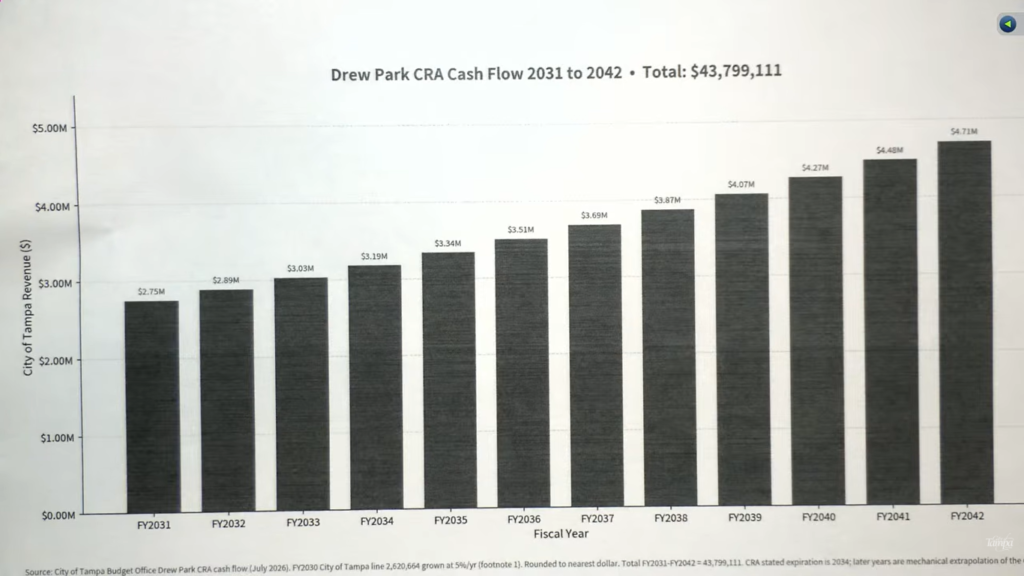
At the heart of the discussion were new financial projections. Councilmember Bill Carlson outlined an 11-year extension to the Drew Park CRA through 2042 that, under a “conservative” 5% annual growth estimate, would capture approximately $44 million in property tax revenue for the neighborhood.
Carlson emphasized that while original plans called for a full takeover of the CRA, which would have led to “massive gentrification,” a separate TIF district stadium will preserve Drew Park’s independence.
“There’s no money being generated in that area now,” Carlson added. “So, that will be all new money for … the CRA board to spend if Drew Park wants gentrification or some growth. They would not have gotten this $44 million without the extension. That’s because of the Rays deal.”
Astorquiza said she needed time to “digest” the somewhat confusing projections. Drew Park already lost nearly a third of its footprint to Tampa International Airport’s past expansion, and the CRA’s remaining industrial corridor along Lois and Grady Avenues now faces severe disruption, she explained.
Drew Park’s current annual revenue of roughly $3.5 million should not be spent fixing problems created by stadium construction, Astorquiza said. She advocated for “two funds if we have direct issues now.”
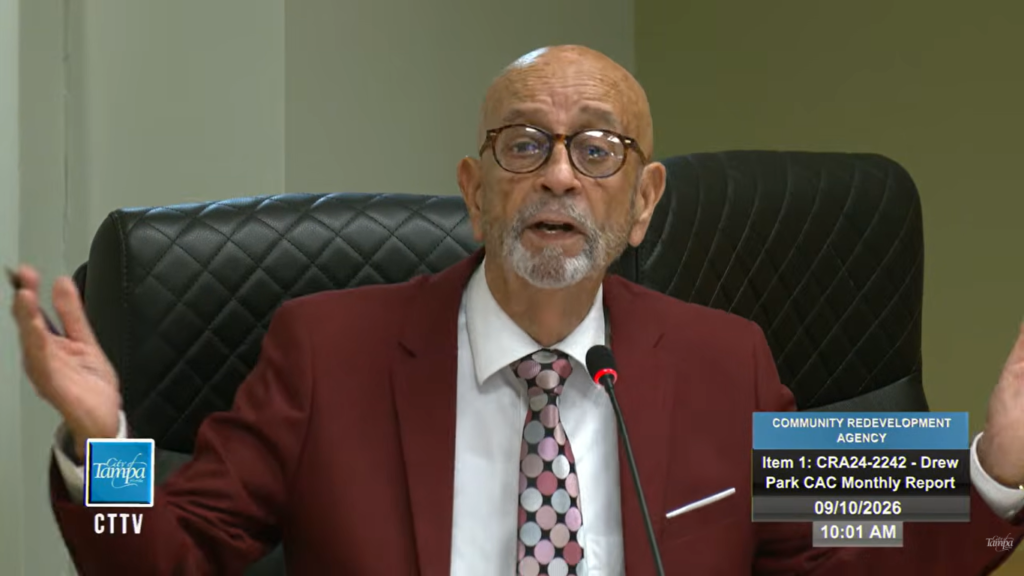
Astorquiza’s skepticism escalated into a sharp condemnation from Councilmember Charlie Miranda, who represents the area. “When you look around and see what’s really happening, it’s a takeover of government without a revolution,” he said, while highlighting the loss of land and facilities within the CRA.
“It’s a hostile takeover with a pen.”
The proposed CBA listed several planned community commitments. It also lacked a dollar amount until County Commissioner Chris Boles amended the agreement to mandate a $60 million minimum spend before Hillsborough approved the stadium deal.
Early promises of affordable housing have morphed into vague statements that the Rays-funded units would be built “somewhere else,” Miranda noted. He questioned whether small businesses could survive an influx of stadium traffic from 81 home games, and warned that land speculation will rapidly price out existing owners.
“You won’t be able to buy a damn thing in Drew Park in another three or four years,” Miranda said.
Council members were separately scheduled to discuss proposed changes to the Drew Park, Downtown, West Tampa and East Tampa CRAs. They postponed that hearing, and another on the CBA, to Nov. 12.
Board attorney Clifford Shepard blamed the delay on critical information needed to draft the final legal paperwork. “There’s been a bit of confusion on what it is that needs to be drafted,” he said.
Council Chair Alan Clendenin told the Tampa Bay Times that the postponements will not prevent the Rays from moving forward with the stadium project. “I wouldn’t be surprised to start seeing some land work and some shovels out there within the next weeks,” he said.