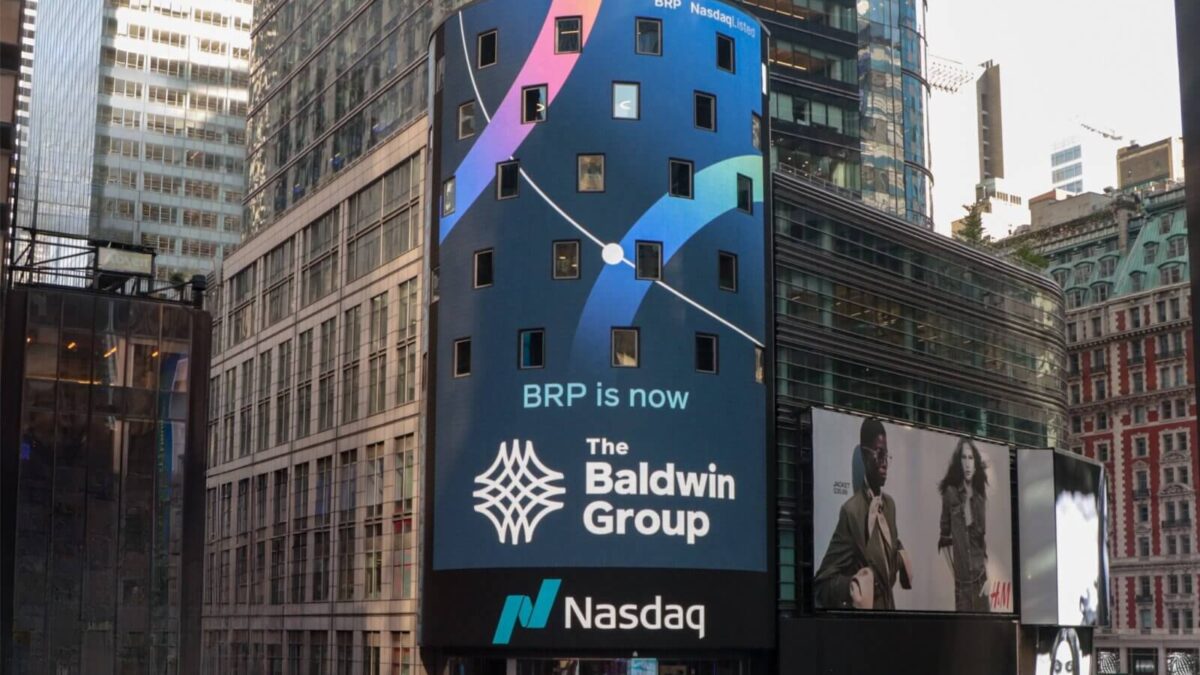
In a massive corporate shakeup for Tampa, insurance brokerage giant The Baldwin Group is going private through a $7.7 billion buyout fueled by high-profile family investment money.
Trading quarterly scrutiny from Wall Street for the deep pockets of private backers, Baldwin announced Sept. 15 that it has reached a definitive agreement to be acquired by a newly formed entity. The buyers are Sequence Holdings and DFO Management, the family investment office of Dell Technologies founder Michael Dell.
The all-cash transaction values Baldwin’s equity at approximately $4.6 billion, with the buyers assuming or refinancing another $3.1 billion in net debt. For shareholders of the Nasdaq-listed brokerage, the deal delivers an immediate windfall: $32.50 per share.
That per-share sales price represents an 88% premium over the stock’s closing price on June 17, the day before rumors of a take-private transaction first began to circulate. Baldwin will become a privately held company upon completion of the acquisition, with “eligible colleagues retaining a significant minority equity stake,” the announcement states.
For the firm, which serves more than 3 million clients globally, the pivot from public markets is about changing speeds. With roughly 5,000 employees and $1.7 billion in trailing twelve-month revenue, Baldwin’s footprint is immense, and the new owners are betting heavily on modernizing its infrastructure.
“Our vision and strategy are not changing,” said CEO Trevor Baldwin in a statement. “What changes is the pace of our investments in talent and technology. Moving faster on AI sharpens what we deliver for clients and elevates the work our colleagues do every day.”
Sequence Holdings will help the Tampa brokerage take a technological leap. The New York-based holding company is known for acquiring and transforming service-economy enterprises through artificial intelligence.
“Atlas,” a proprietary technological platform Sequence will deploy across Baldwin’s operations, is at the center of that transformation. The system rebuilds and enhances processes, workflows, products and services “around what is now possible,” according to the company.
“Sequence brings leading engineering talent and patient capital to each of the businesses with which we partner in order to transform them into market leaders,” said CEO Michael J. Lee.
The buyout’s capital structure makes it particularly notable. DFO Management, which steers the Dell family’s extensive assets, invests without an expiration date instead of a rigid timeline.
“DFO invests with the flexibility and patience of permanent capital, not as a fund working against a fixed exit clock,” said founder Michael Dell. “That structure enables DFO to back proven operators like Trevor (Baldwin) and his team for the long term.”
Dell praised Baldwin for building “something rare in insurance distribution: a genuine data and platform advantage, compounded over 15 years.” He also credited the local firm’s “differentiated vision.”
The acquisition highlights a growing trend in the financial sector: Ultra-wealthy family offices stepping into mega-deals that were once the exclusive domain of Wall Street’s largest private equity firms. “I am excited that the DFO team is partnering with Sequence Holdings to support Baldwin’s next chapter with patient capital and engineering and operational expertise,” Dell said.
The deal is expected to close in the first quarter of 2027, but won’t cross the finish line without the standard gauntlet of legal scrutiny. Almost immediately following the announcement, multiple shareholder rights law firms announced investigations into whether the $32.50 per share price fairly values the company.
According to Kaskela Law, “numerous stock analysts” maintained a $36.00 per share price target on Baldwin stock. Attorneys will examine if the board of directors adequately protected shareholder interests during negotiations.
While such investigations are a customary, almost reflexive reaction to public buyouts, the scrutiny introduces a layer of friction. Crucially for Tampa, the buyout isn’t an extraction of local wealth.
The deal is structured to keep the rank-and-file deeply invested, according to the announcement. Eligible employees who currently hold equity can roll over a portion of their holdings into the new private enterprise.
That will ensure the workforce retains a significant minority equity stake alongside billionaires and holding companies, preserving what the firm describes as a “long-standing commitment to broad-based colleague ownership.”