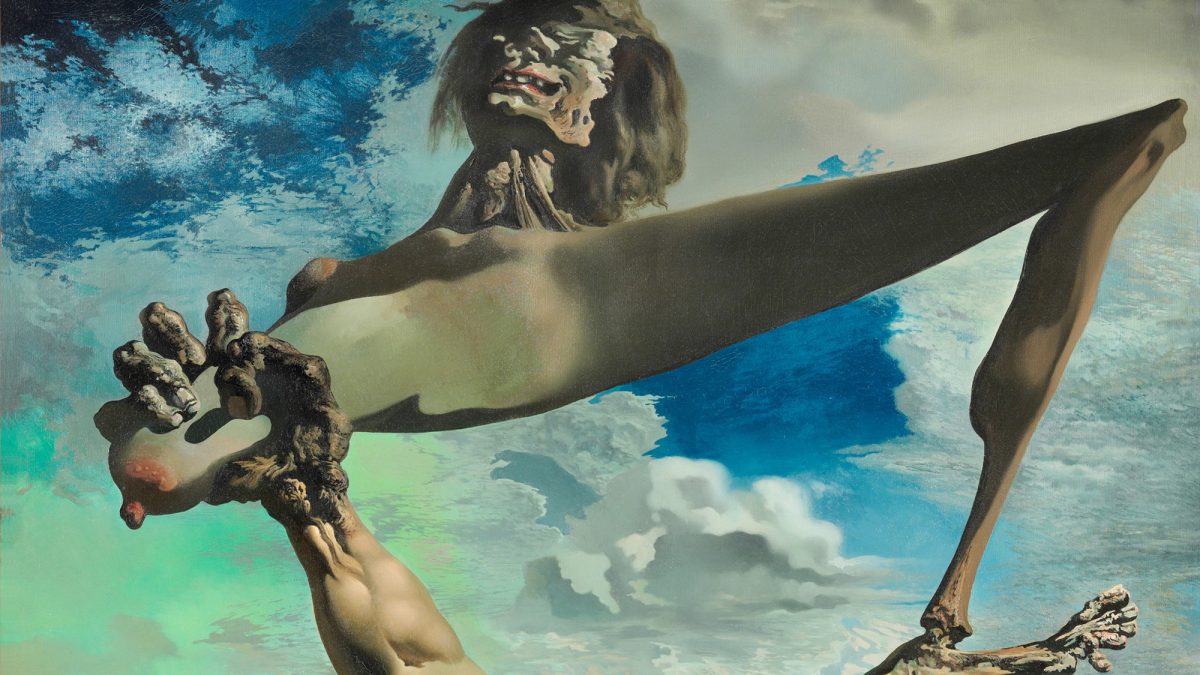
A monumental 1936 Salvador Dalí masterpiece depicting the visceral horrors of civil war has arrived in St. Petersburg.
On loan from the Philadelphia Museum of Art, Soft Construction with Boiled Beans debuts at the Dalí Museum on Friday. The unsettling oil on canvas offers a dark look at collective self-destruction.
Widely regarded as one of the surrealist master’s finest works, the painting depicts a giant, grotesque and dismembered body locked in a violent, desperate wrestling match with itself. Dalí subtitled the piece Premonition of Civil War; approximately 500,000 people would soon die in the Spanish Civil War, which erupted a few months after its completion.
“This thing is almost like a Hollywood poster for horror,” said Curator Peter Tush. “It’s singular, it’s massive, it’s overwhelming and it’s so well-painted it’s pretty disgusting. It doesn’t give in to the idea of beauty at all.”
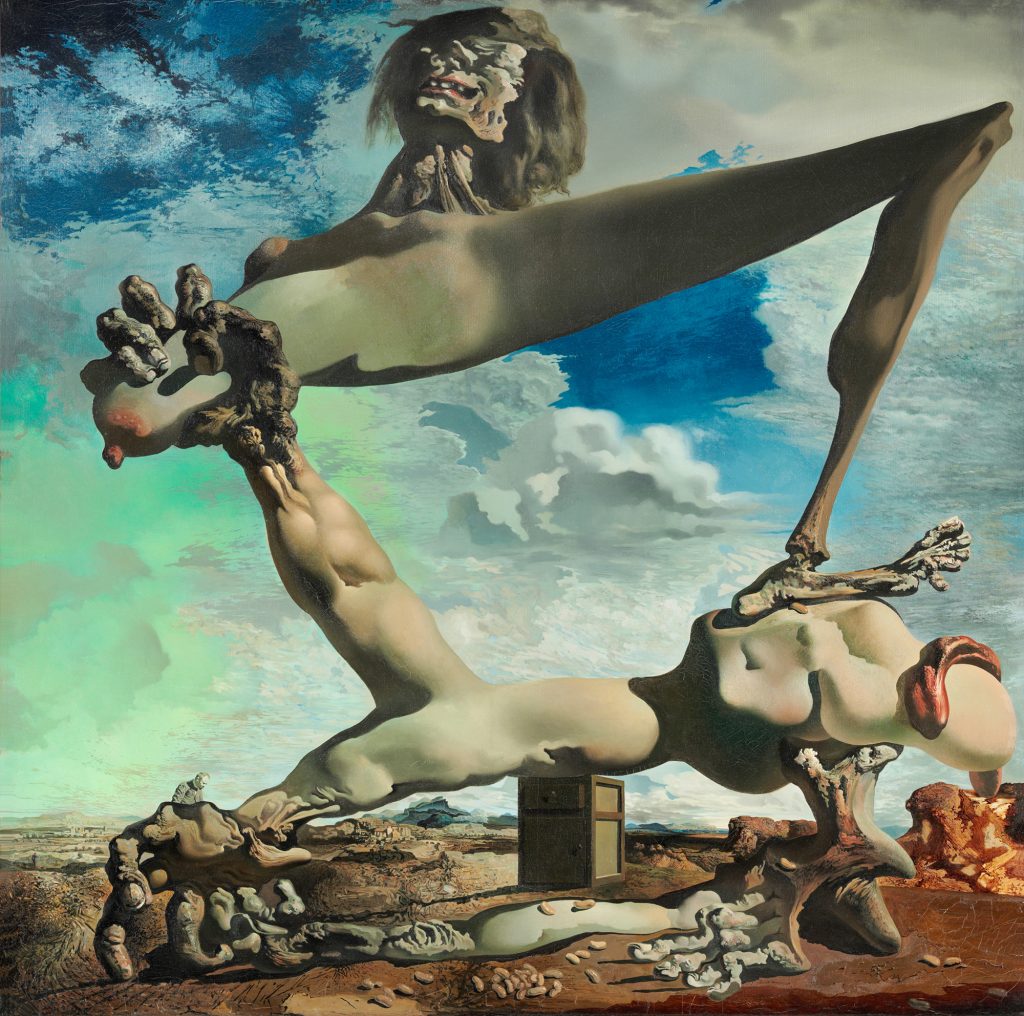
The canvas features grotesque details: a figure sitting atop a modern chest of drawers, toxic-colored skies that suggest released gas, scattered beans and a piece of raw meat that Tush noted looks as if “it’s going to start having a smell.”
Dalí once remarked that one could not consume that much raw meat without some “melancholy vegetable” for balance. Yet beneath the surrealism lies a stark commentary on political violence and a nation’s collapse.
Tush said the painting’s arrival during a fractured American political climate is a fortuitous coincidence. “It’s definitely a painting about how one community can come to find the things they hate the most in their neighbors, and so that resonates very powerfully with this moment.”
“It’s just that sense that sides can become polarized very quickly, and the result can be something as horrific as what Dalí envisioned,” Tush added. “He was witnessing the same thing happening in Spain in 1934.”
Unlike his contemporary Pablo Picasso, whose masterpiece Guernica was fueled by emotional rage at the bombing of the Basque town, Dalí maintained a strict neutrality throughout the Spanish Civil War, Tush explained. Soft Construction also offers a deeply psychological, dreamlike unease, while Guernica delivers a sharp, arresting jolt of human agony.
“Dalí’s work is more objective,” Tush said. “It’s not brought out by emotion, but rather a clinical detachment – a sense that civil war and the process of civil war is almost something that can be observed at a distance.”
That distant observation is literally painted into the canvas. In the bottom corner stands a tiny figure Dalí later called the “chemist of Ampurdan,” which was inspired by a magazine photograph of a man operating a respirator pump.
Tush interprets that figure as missing the obvious horror unfolding directly in front of him. “That’s what makes Dalí’s work so weird and, in a way, difficult for us, because it is so clinical,” he said.
“It’s like an observation without even being interested in which way the sides are leaning,” Tush continued. “It’s just a sense that this will happen, and it’s horrific.”
Securing the loan was a logistical victory for the St. Petersburg institution, which houses the largest collection of Dalí’s works outside of Spain. Tush said the museum previously loaned an extraordinary work to the Philadelphia Museum of Art for its centenary surrealism exhibition, which paved the way for this reciprocal arrangement.
The museum recently loaned 20 of its best works to the Museum of Fine Arts, Boston. That institution is now co-organizing “Dalí: Disruption + Devotion,” an extensive exhibition that debuts in St. Petersburg on Nov. 7.
The exhibition will feature five centuries of rarely lent works from Dalí’s renowned predecessors, including El Greco, Diego Velázquez, Luis Meléndez and Francisco Goya.
While the St. Petersburg museum boasts an expansive permanent collection, Tush noted it lacks a few pivotal masterpieces. He said showcasing Soft Construction provides a fuller story of Dalí’s technical evolution.
Tush called Soft Construction one of Dalí’s “absolute best painted works.”
“The quality and technical application of paint is extraordinary,” he said. “It’s like he (Dalí) had hit his stride as a person able to imagine the impossible and then share it with us. A painting like this is just really a once-in-a-lifetime opportunity.”
Soft Construction with Boiled Beans will be on display through April 19, 2027.