St. Petersburg is again positioning itself as a launchpad for aerial innovation more than a century after the world’s first commercial flight departed from the city’s waterfront.
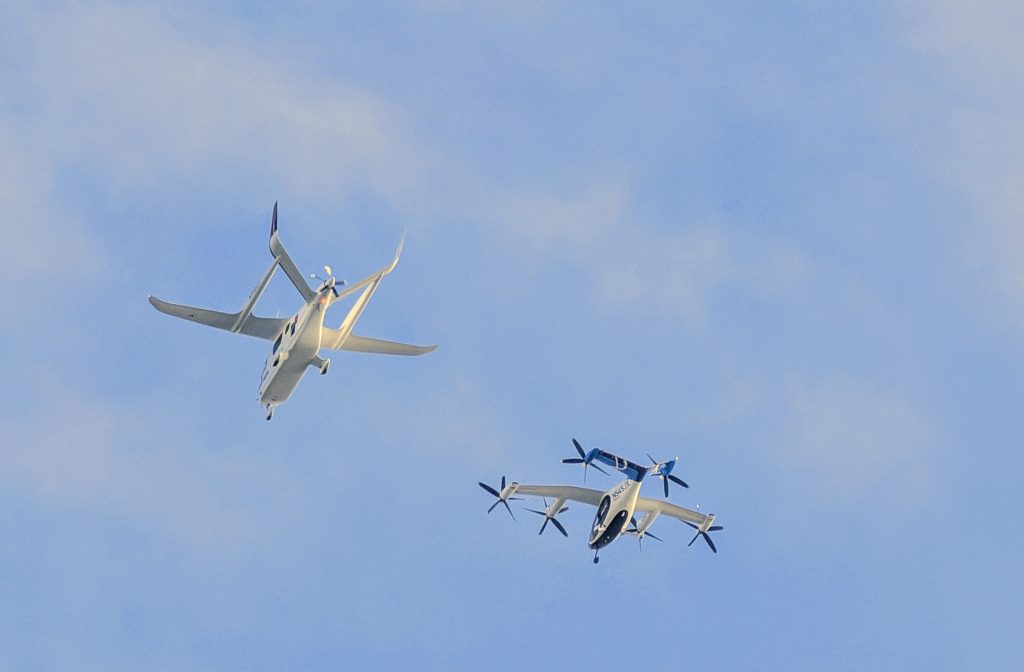
Joby Aviation and BETA Technologies showcased the next generation of regional transit Friday morning at Albert Whitted Airport. Two electric aircraft retraced a cross-bay route Tony Jannus made in 1914 when the first commercial flight took off in the Sunshine City and landed in Tampa.
St. Petersburg has already made advanced air mobility (AAM) history by creating the state’s first industry-focused task force, led by former City Councilmember Ed Montanari. Lydon Sleeper, head of U.S. policy for Joby Aviation, told the Tampa Bay Reporter that air taxis could begin carrying regional passengers “as early as the second half of next year.”
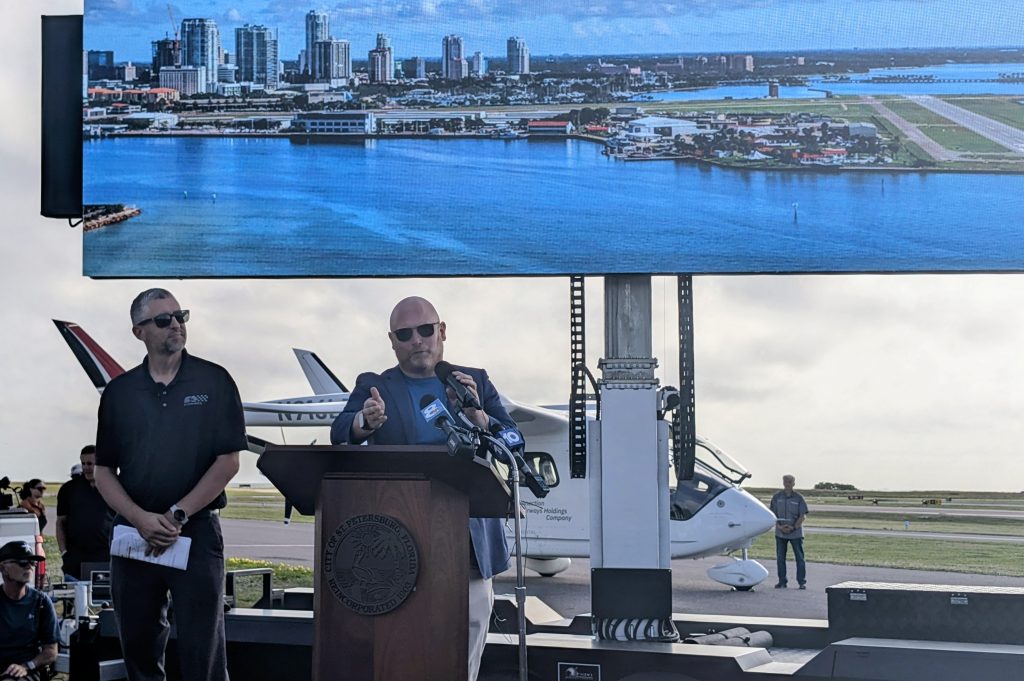
“We’ve been working with you all for years to think about how to integrate advanced air mobility into the St. Pete, Tampa and Florida ecosystem,” Sleeper said. “We would not be here if it weren’t for your forward-thinking vision, and everything that you’ve done to bring us to this point.”
AAM is a nascent aerospace sector that typically utilizes electric vertical takeoff and landing aircraft (eVTOLs) to move people and cargo. While often called air taxis, the vehicles can also provide disaster relief, search and rescue, delivery and surveillance services.
Friday’s demonstration offered a vivid look at a technology that could revolutionize regional transit by bypassing congested roadways. Sleeper noted his morning commute over the Howard Frankland Bridge took over 50 minutes; the two electric aircraft made it to Tampa International Airport in less than 10.
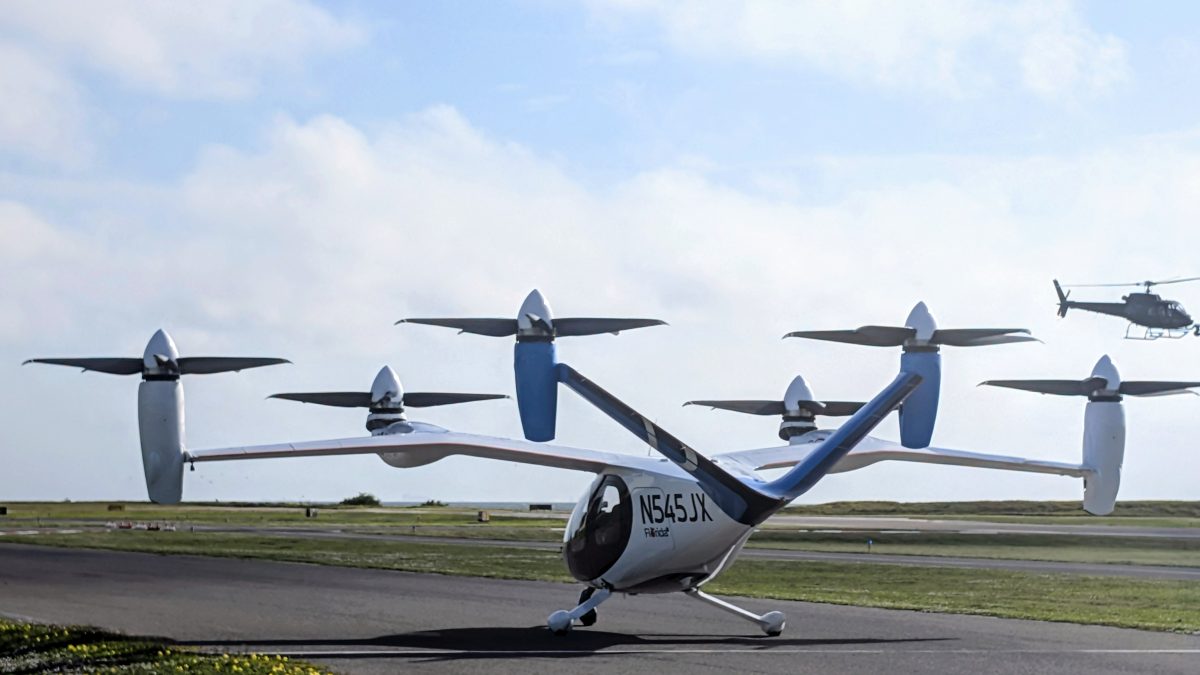
Joby highlighted its S4 aircraft, which features six propellers, each powered by dual-wound electric motors to promote safety and redundancy.
“If we lose one part of that dual-wound electric motor, the opposite redundant one immediately powers back up,” Sleeper explained. “If we lose an entire propeller, the opposite redundant propeller powers down, and we can still take off and land vertically on four. And if something more were to happen … we can come in and land on the wing.”
Zero-emission eVTOLs operate at the volume of a typical conversation. Traditional airplanes taking off from Albert Whitted provided a stark contrast.
Vertiports, specially designed helipads for eVTOLs, typically include charging stations and fire safety systems. However, nearly any flat surface will suffice.
The goal is to seamlessly integrate eVTOLs into urban areas and transport passengers to where they live, work and play without noise or environmental pollution. Sleeper said the AAM industry has “incredible” potential in Tampa Bay.
Vince Morgan, test engineering lead at BETA Technologies, showcased the CX-300 conventional takeoff and landing (CTOL) aircraft. It uses a traditional runway but operates entirely on electric propulsion.
The CTOL plane on display shares 80% of its components with BETA’s eVTOL model. The technology is already well tested; Morgan said the CX-300 has flown over 250,000 nautical miles – equivalent to 11 trips around the globe – with zero failures.
To prove the viability of electric regional flights, Morgan spent the week traveling between the Space Coast and Tampa Bay. They logged over 1,000 nautical miles across more than 20 trips.
Nine air taxi charging stations are currently active statewide. The Florida Department of Transportation is building an aerial highway above the I-4 corridor and an AAM testing facility in Polk County.
“You may see us pretty soon,” Sleeper said of regular commercial flights in Tampa Bay. Today, city leaders see AAM not just as a transportation upgrade, but as an untapped economic engine.
“From our Innovation District and growing technology sector to our partnerships across business, education and research, St. Pete is building an environment where new ideas can take flight – literally and figuratively,” said Mayor Ken Welch.
Montanari, a former fighter and commercial jet pilot appointed by Welch to oversee the AAM task force in January 2025, echoed that sentiment. He urged stakeholders to envision a comprehensive network of vertiports connecting Albert Whitted Airport to the rest of the state and the world.
“Imagine a center for aviation and innovation right here in the city of St. Petersburg,” Montanari said. “Imagine a place where students learn the technologies of tomorrow, where companies develop new aircraft and systems, manufacturers create jobs and where industry leaders come together to shape the future of aviation.
“This is more than an aviation vision. This is an economic development vision.”
As the electric aircraft took flight across the bay, the parallels were impossible to ignore. More than a century after a wooden seaplane changed global transit, St. Petersburg is once again preparing to revolutionize the skies.