
The average U.S. physician manages more than 2,000 patients, creating care gaps for those who need it most. Tampa-based Nemea Health has built an AI-powered bridge.
Nemea Health plans to formally unveil its continuous clinical intelligence bot, dubbed Vasi, on January 1. The holistic platform, which incorporates health histories and social determinants, helps monitor complex patients, notifies all stakeholders of any abnormalities and recommends evidence-based next steps.
The overarching goal is to mitigate hospital readmissions and emergency room visits by identifying subtle warning signs. Nemea Health’s mission is deeply personal for founder Betsy Callas, a breast cancer survivor.
Callas subsequently spent years helping family members navigate the healthcare system. She most recently served as the primary caregiver for her mother, who was battling several critical illnesses.
“Through that, I perfected the caregiving aspect of Nemea,” Callas said. “What my vision was, and the ability to help millions of people, has now become a reality through today’s technology.”
Callas, a former strategic advisor for Fortune 100 companies, particularly those in the life sciences sector, said she conceived the framework for continuous patient monitoring nearly 20 years ago. While the needed technology didn’t exist then, recent AI advances have finally made her vision for Nemea Health viable.
The healthtech company launched in early 2025. “I started building it, and it’s a complete product today,” Callas said of the proprietary platform.
Nemea Health operates on a business-to-business model, targeting major healthcare systems rather than individual patients. Hospitals, clinic networks and primary care physicians pay a subscription fee to deploy Vasi.
The AI acts as an around-the-clock intermediary, triaging symptoms and escalating critical issues directly to a physician’s dashboard. Rachel Scharfman, vice president of marketing, emphasized that the platform is fully HIPAA-compliant.
Scharfman said patients can also dictate what information Vasi shares with caregivers or doctors, which provides a customizable privacy layer. “That’s completely a game changer in the AI space.”
Caregivers and patients can upload information and interact with Vasi through any compatible digital device. Callas noted that clinicians regularly see thousands of patients, and “there’s no way they could be there for them all when they need them.”
“This enables the patients and caregivers to have 24-hour access to whatever they need when they need it, and it’s escalated,” she added. “The clinicians have a seamless view of what’s going on with the patients and caregivers at that time.”
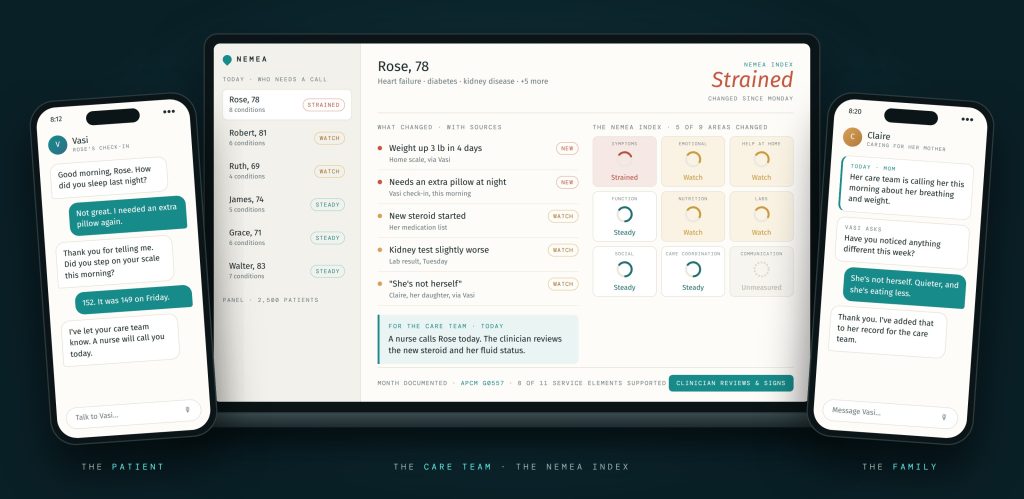
Nemea Health uses an index that weighs clinical symptoms alongside social determinants of health, the socioeconomic conditions that heavily influence medical outcomes, to assess patient risk factors.
If a patient’s blood pressure spikes, Vasi logs the clinical data. But if that same person misses multiple appointments because they lack reliable transportation, the platform flags the logistical hurdle as a health risk.
“It looks at the whole person, the resources they have … which is a big measure,” Callas said. “It’s what happens to the patient not only physically and clinically, but socially, psychologically, mentally and emotionally as they go through this journey.”
That holistic approach is increasingly vital, as wait times for specialized care can stretch for half a year or longer. Callas recalled that securing a cardiologist appointment for her mother in Pinellas County took six months; an appointment with a specialist at Tampa General Hospital took nine.
Patients are often left to manage their symptoms alone during those prolonged waits. Nemea Health plans to fill that void with clinically backed intelligence that incorporates over 38 verified medical resources.
A strict reliance on established clinical studies and data serves as a guardrail against “hallucinations” – a common flaw in open-source AI models where the technology invents plausible but false information. “This is personalized specifically to all of their electronic health records,” Callas explained.
“When a person comes in, we have all of their information. It is exactly what they need to do and what their path is… This is all clinically proven guidance.”
Scharfman said Vasi will not provide an answer or recommendation without clinical evidence. Instead, the platform will instruct patients to call 911 or their healthcare providers.
The financial incentive to adopt Nemea Health is tied directly to preventive care and federal compliance. The platform automatically tracks and reports complex care metrics required by the Centers for Medicare & Medicaid Services (CMS).
More importantly, early intervention reduces the strain on overcrowded emergency rooms. “If we’re keeping them out of the ER, then there is significant cost savings there,” Scharfman said.
“Because we’re lowering readmission rates, we’re improving outcomes, we’re improving quality of life,” she continued. “And then the hours that the caregiver sits in the hospital that they don’t have to sit in because we intervened at an earlier time.”
Callas recently secured a strategic partnership with Amazon Web Services (AWS), which provided non-dilutive funding and is completing Nemea Health’s tech infrastructure. She has also launched an inaugural seed funding round after bootstrapping the company.
Nemea Health is now enlisting doctors and health systems for pilot programs. “I think it’s an exciting time to be in the space that we’re in,” Callas said.